

Color Consistency in Packaging: Why X-Rite Color Management Matters for Brand Owners
Ask any brand manager who has sourced packaging from multiple suppliers across multiple countries, and they will likely say the same thing:
Color is one of the hardest things to get right — and one of the most visible things to get wrong.
The red on one packaging batch looks different from the red on the next shipment. The blue used for the European version does not match the blue used for the North American version. The approved proof looked correct, but the final production run came out slightly different.
These are not minor design issues. For brands that rely on color consistency to build recognition and trust, packaging color inconsistency is a real quality problem.
This guide explains why packaging color is difficult to control, what X-Rite color management is, how professional color control works, and what it means when a packaging supplier uses X-Rite systems in production.
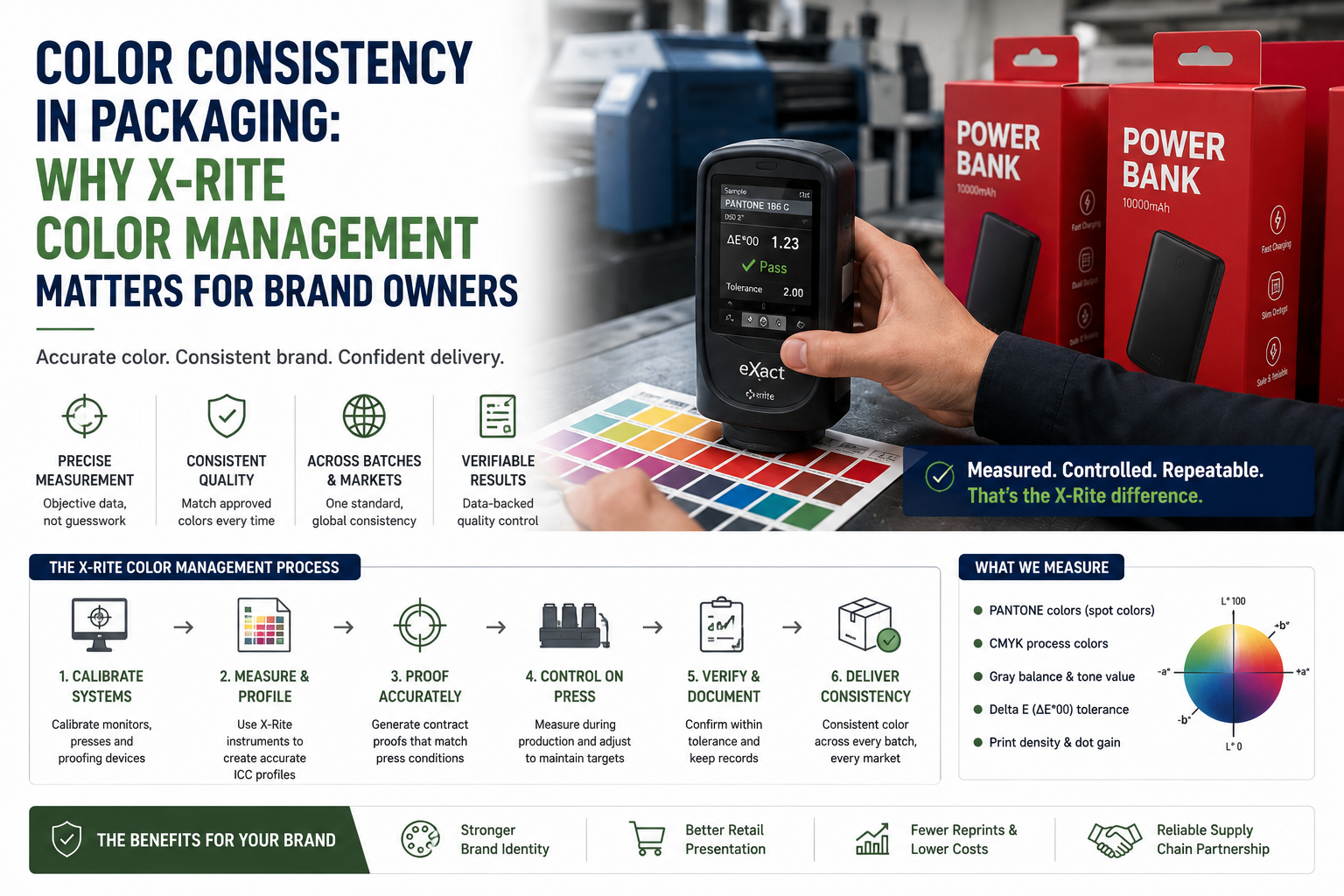
Why Color Consistency Matters in Packaging
Packaging color is part of brand identity.
Customers may not consciously compare color values, but they notice when packaging looks inconsistent on the shelf. Retailers also notice when different batches, SKUs, or market versions do not match.
Color inconsistency can affect:
Brand recognition
Retail shelf appearance
Product line consistency
Customer trust
Buyer approval cycles
Reorder quality
Supplier credibility
For global brands, color consistency is especially important because packaging may be produced across different regions, suppliers, presses, and substrates.
Without professional color management, each production run carries a higher risk of visible color drift.
Why Color Is So Hard to Control in Packaging Printing
Printing color is not a fixed digital value.
It is a physical result created by ink, substrate, press conditions, environment, and human perception.
Even when the same artwork file is used, the final printed result can change because many variables affect color reproduction.
Key Factors That Cause Color Drift
1. Ink Viscosity and Pigment Concentration
Printing ink is made from pigments and liquid carriers.
Even small differences in pigment concentration or ink viscosity can affect the final color.
Ink mixed at different times may look slightly different, even if the formula is technically the same.
2. Paper and Board Substrate
The same ink can look very different on different materials.
For example, the same blue ink will not appear identical on:
Bright white SBS paperboard
Brown kraft board
Coated folding carton board
E-flute corrugated board
Matte laminated surface
Gloss laminated surface
Substrate brightness, absorbency, coating, and surface texture all affect how printed color appears.
Even the same board grade from different production batches can vary slightly.
3. Ink-Water Balance in Offset Printing
Offset lithographic printing uses both ink and water.
The balance between ink and water affects ink density, dot gain, and color stability.
As a press warms up during production, or as moisture levels change, this balance can shift.
If it is not measured and controlled, color can drift during the production run.
4. Dot Gain
Dot gain occurs when printed dots spread on the paper after ink transfer.
This can make midtones darker and shift color balance.
Dot gain can be affected by:
Ink tack
Paper absorbency
Press speed
Temperature
Blanket condition
Substrate moisture
Professional color management measures and compensates for dot gain.
5. Temperature and Humidity
Pressroom conditions directly affect printing.
Temperature and humidity can influence:
Ink viscosity
Paper moisture content
Sheet dimensions
Press mechanical behavior
Ink transfer stability
A factory with poor environmental control may produce different color results across seasons.
6. Press Wear Over Time
Printing presses change as they age.
Rollers, cylinders, blankets, and mechanical parts wear over time. These changes affect ink transfer and color reproduction.
Without regular recalibration, even a high-end press can drift away from its original color standard.
What Is X-Rite?
X-Rite is a leading manufacturer of professional color measurement instruments and color management software.
Its tools are widely used across printing, packaging, paint, plastics, textiles, photography, and digital imaging.
In the packaging industry, X-Rite instruments are commonly used to:
Measure color during production
Calibrate proofing systems
Verify Pantone and CMYK targets
Support G7 press calibration
Monitor color consistency across production runs
Create and verify ICC profiles
Provide objective color measurement records
When a packaging manufacturer uses X-Rite color management, it means the factory is using professional measurement tools rather than relying only on visual judgment.
That difference matters.
Visual inspection can be useful, but it is subjective. X-Rite measurement provides numerical, repeatable, and documented color data.
Core X-Rite Tools Used in Packaging Color Management
Professional color management usually includes several types of tools.
Each tool has a specific role in measuring, controlling, and documenting print color.
1. Spectrophotometer
A spectrophotometer measures how a surface reflects light across the visible spectrum.
This gives a complete mathematical description of a printed color.
In packaging printing, the spectrophotometer is the primary instrument used for accurate color measurement.
It is used to:
Measure printed color samples
Compare production sheets against approved targets
Verify Pantone color accuracy
Support G7 calibration
Create ICC profiles
Record color performance during production
X-Rite eXact
X-Rite eXact is a widely used handheld spectrophotometer for press-side color measurement.
Press operators use it to measure printed color during production and compare the result with approved target values.
It helps operators decide whether ink adjustments are needed before or during the production run.
X-Rite i1Pro
X-Rite i1Pro is commonly used in pre-press and color profiling workflows.
It supports:
Monitor profiling
Proofing printer calibration
Press profiling
ICC profile creation
G7 characterization
It helps connect pre-press color expectations with actual production press behavior.
X-Rite iSis and iO
X-Rite iSis and X-Rite iO systems are automated scanning spectrophotometer systems.
They can measure printed color targets at high speed and are useful for:
Creating ICC profiles
Measuring large color charts
G7 characterization
Press condition monitoring
Repeatable automated measurement
2. Densitometer
A densitometer measures ink density.
It is simpler than a spectrophotometer, but it is useful for fast press-side monitoring.
Densitometers are commonly used during:
Press make-ready
Density control
Basic ink film monitoring
In-run checking
While densitometers are useful, they do not provide the same full spectral color data as spectrophotometers.
3. ColorCert and PantoneLIVE
X-Rite also offers software platforms that help manage color across suppliers and facilities.
X-Rite ColorCert
ColorCert is a color quality management platform.
It can collect and organize color measurement data across presses, proofing systems, and production facilities.
For brand owners, this helps monitor whether suppliers are meeting color specifications.
PantoneLIVE
PantoneLIVE is a cloud-based platform that stores spectral definitions of Pantone colors for specific materials and print conditions.
This is more accurate than relying only on printed Pantone books, which can age, fade, or vary under different lighting conditions.
PantoneLIVE helps suppliers reproduce brand colors more consistently across different substrates and facilities.
How Professional Color Management Works
A real color management workflow is not just a device sitting beside a press.
It is a complete process that connects press calibration, proofing, artwork preparation, production measurement, and quality documentation.
Step 1: Press Characterization
Before a press can be controlled, its color behavior must be measured.
This process is called press characterization.
The factory prints a standardized test target, then measures the printed color patches using a spectrophotometer.
This creates a press characterization data set that describes how that press reproduces color under specific conditions.
This data can be used to:
Create ICC press profiles
Adjust tone curves
Support G7 calibration
Predict how artwork will print
Improve proof accuracy
Step 2: G7 Calibration
G7 calibration adjusts the press so that its gray balance and tone reproduction match recognized standards.
Once a press is calibrated, it operates in a known and predictable color state.
This makes future color management more reliable.
For brand owners, G7 calibration helps reduce color variation between different production runs, presses, and facilities.
Step 3: Proofing System Calibration
A printed proof is only useful if it accurately predicts production output.
Professional factories calibrate their proofing systems to match the production press.
Using X-Rite measurement data, the pre-press team creates a proofing profile that maps proof output to press output.
The result is a more reliable contract proof.
Without this step, a proof may look attractive but still fail to represent the final printed package accurately.
Step 4: Pre-Press Color Management
When artwork arrives, the pre-press team prepares it for the target print condition.
This may include:
RGB to CMYK conversion
ICC profile application
Ink limit adjustment
Soft proofing
Image correction
Substrate-specific color adjustment
Contract proof generation
At Huandao, pre-press work uses calibrated monitors and X-Rite-supported proofing workflows to help ensure that screen previews, proofs, and production output are aligned.
Step 5: Press Make-Ready and Approval
Before mass production begins, the press is set up for the job.
The factory prints make-ready sheets and measures them against the approved target.
The process usually includes:
Printing the initial make-ready sheet
Measuring color using an X-Rite spectrophotometer
Comparing measured values with the approved proof or target data
Adjusting ink density and color balance
Repeating measurement until the sheet is within tolerance
Signing off the approved press sheet before full production
The approved press sheet becomes the reference for the full production run.
Step 6: In-Run Color Control
Color must be monitored during production, not only at the start.
During a print run, the factory may print control strips on each sheet. These strips contain color patches that can be measured at regular intervals.
The operator compares measurements against the approved standard.
If the color moves outside tolerance, corrective action should happen immediately.
This prevents a full production batch from being completed before color problems are discovered.
Step 7: Closed-Loop Press Control
Some high-specification offset presses support closed-loop color control.
In this system, color measurement data is fed directly into the press control system.
The press can automatically adjust ink delivery to maintain color consistency during the run.
This reduces manual error and helps maintain stable color over long production runs.
Huandao uses KBA presses with closed-loop color control for high-quality packaging production.
Step 8: Quality Records and Traceability
Professional color management creates records.
These records document whether the job was produced within specification.
Color measurement records are useful for:
Quality disputes
Reorder comparison
Internal process improvement
G7 and GMI compliance
Customer reporting
Long-term brand color control
For repeat orders, previous measurement records can be used as a reference to ensure the new production run matches the approved standard.
What X-Rite Color Management Means for Brand Owners
For packaging buyers, X-Rite color management provides practical benefits that affect approval speed, color reliability, and supplier accountability.
1. More Consistent First-Time Approval
When proofing and production systems are properly calibrated, the approved proof is more likely to match the production run.
This reduces:
Repeated proofing
Color correction rounds
Production delays
Approval uncertainty
Last-minute disputes
For brand-critical packaging, this can save significant time during launch or reorder programs.
2. Measurable Color Standards
Professional color management makes color measurable.
Instead of saying a color “looks close,” the supplier can measure the difference between the target color and the printed color.
This is often expressed using Delta E, written as ΔE.
Delta E measures the difference between two colors.
ΔE 0 means the colors are identical
ΔE above 3 is often visible to many observers under controlled conditions
ΔE above 5 is clearly visible as a color difference
With X-Rite measurement, buyers can specify color tolerance requirements such as:
Delta E ≤ 2 for brand-critical Pantone colors
The supplier can then provide measurement data to verify compliance.
3. Better Reorder Color Reliability
Many brands experience gradual color drift over time.
One reorder looks slightly different from the previous order. After several years, the packaging may no longer match the original approved sample.
This often happens when color standards are not measured, documented, or recalibrated.
With X-Rite-managed color, the supplier can:
Use the same target data for repeat orders
Compare new production against previous records
Recalibrate presses to the same standard
Maintain consistent color across time
This improves long-term packaging consistency.
4. Cross-Facility Color Consistency
Brands that use multiple suppliers or production facilities need a shared color standard.
If each facility interprets color visually, results will vary.
If all facilities use calibrated measurement systems and common standards, color becomes more transferable.
X-Rite color management provides a technical foundation for more consistent color across factories, markets, and production schedules.
5. Better Supplier Accountability
A supplier with X-Rite color management can provide data.
This makes quality conversations more objective.
Instead of debating whether a color “looks acceptable,” both buyer and supplier can review:
Target value
Measured value
Delta E result
Tolerance standard
Measurement date
Production batch
Corrective action record
This creates a stronger quality control system and reduces subjective disputes.
Questions to Ask Your Packaging Supplier About Color Management
When evaluating a packaging supplier, ask specific questions.
General answers like “our printing quality is good” or “our operators are experienced” are not enough.
Use the questions below to evaluate whether the supplier has real color management capability.
Supplier Color Management Checklist
What color measurement equipment do you use?
Do you use X-Rite spectrophotometers? Which models?
Are your presses G7 calibrated?
What level of G7 certification do you hold?
Can you provide current G7 documentation?
How do you calibrate your proofing system?
What is your Delta E tolerance between proof and press?
How often do you recalibrate your presses?
How often do you measure color during a production run?
Can you provide color measurement records from recent jobs?
How do you store approved color references for repeat orders?
What happens if production color exceeds tolerance?
A supplier that can answer these questions with documentation is more likely to have a real color management system.
A supplier that relies only on visual judgment may not be suitable for brand-critical packaging.
Huandao’s X-Rite Color Management Infrastructure
Huandao’s color management system is built around X-Rite instrumentation and supported by G7 Master and GMI certification.
X-Rite eXact Spectrophotometers
Huandao uses X-Rite eXact spectrophotometers press-side on offset production lines.
They are used for:
Make-ready verification
Production color measurement
Pantone target checking
In-run color control
Quality documentation
X-Rite i1Pro Spectrophotometers
Huandao uses X-Rite i1Pro instruments in pre-press for:
Press profiling
Proofing calibration
ICC profile creation
G7 characterization
Color workflow management
Calibrated Pre-Press Monitors
Huandao’s pre-press department uses color-critical monitors with X-Rite hardware calibration.
This helps ensure that artwork review and soft proofing are more closely aligned with final printed output.
Certified Contract Proof Workflow
Huandao uses X-Rite-profiled proofing printers to produce certified contract proofs.
This allows clients to approve proofs that more accurately predict production output.
KBA Presses With Closed-Loop Color Control
Huandao’s KBA presses support closed-loop color control.
This allows measurement feedback to help adjust ink delivery during production, improving consistency across long runs.
G7 Master and GMI Certification
Huandao maintains:
G7 Master Printer certification
GMI certification for offset production lines
These certifications support technical color calibration and broader print quality management.
Color Measurement Records
Huandao retains color measurement records for production jobs.
These records help support:
Conformance verification
Reorder comparison
Customer quality documentation
Long-term packaging color consistency
Why Brand Owners Should Care About X-Rite Color Management
For brand owners, packaging color consistency is not just a printing issue.
It affects how customers recognize the brand, how retailers evaluate packaging quality, and how efficiently new packaging can move from proof approval to production.
A supplier with X-Rite color management can provide:
More reliable proof-to-press matching
More consistent production color
Measurable color tolerances
Better repeat order consistency
Stronger cross-market brand control
Clear documentation for quality assurance
If your packaging depends on consistent Pantone colors, accurate photography, or multi-SKU retail presentation, professional color management should be part of your supplier qualification process.
Work With a Packaging Supplier That Controls Color Professionally
Color consistency is one of the most visible signs of packaging quality.
A professional packaging supplier should not rely only on experience or visual checking. It should measure, document, calibrate, and control color at every important stage of production.
Huandao uses X-Rite color management infrastructure, G7 Master calibration, GMI-certified quality processes, KBA offset presses, certified proofing workflows, and retained measurement records to help brands achieve consistent packaging color across every order.
Request a Color Management Consultation →
View Our Certifications →
Get a Custom Packaging Quote →
