

If you have ever asked a packaging supplier for a “cardboard box” and received something different from what you expected, you are not alone.
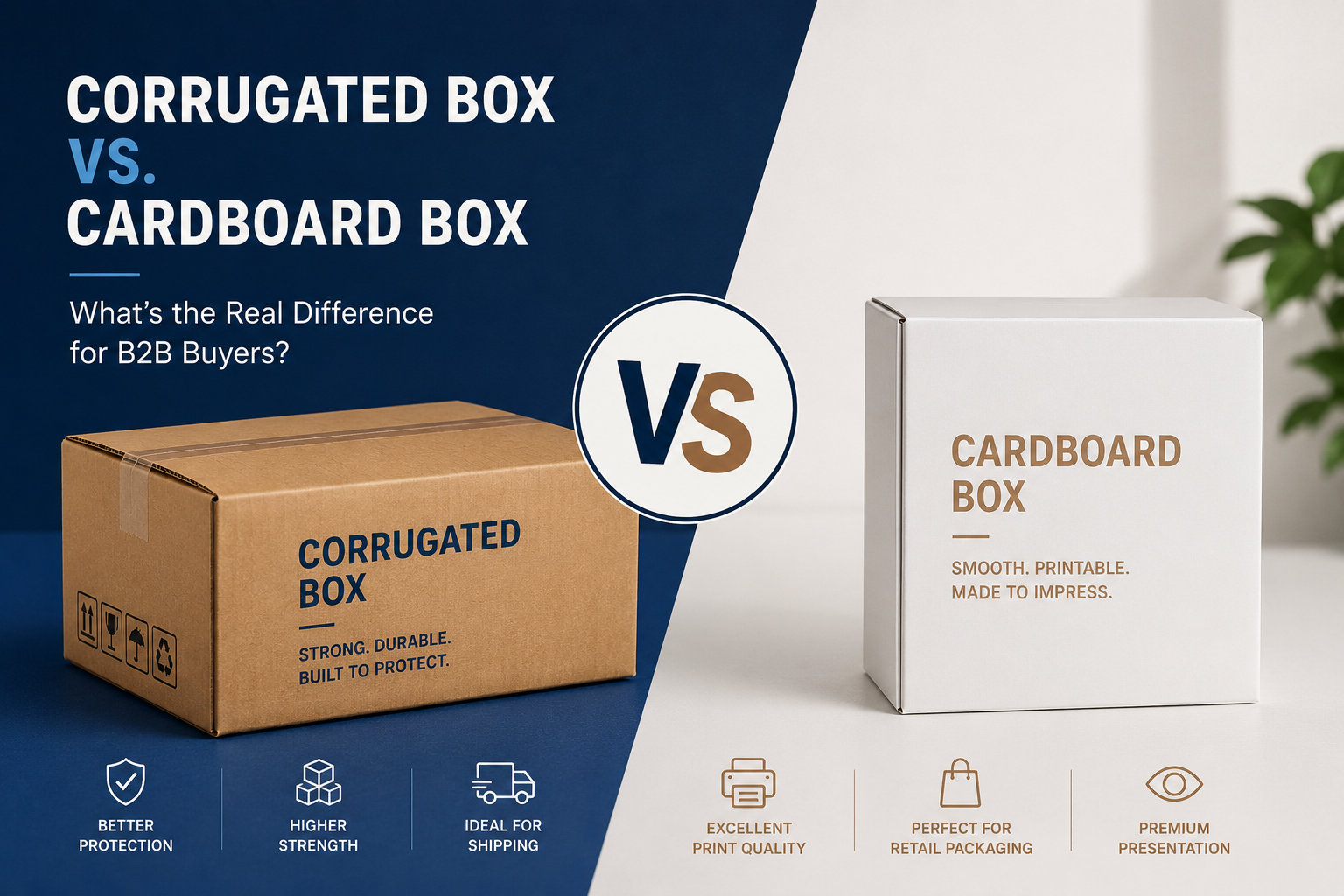
In everyday language, many people use corrugated box and cardboard box interchangeably. However, in the packaging industry, these two terms refer to different materials, structures, and applications.
For B2B buyers sourcing packaging at scale, understanding the difference is important. The right material choice can directly affect:
Product protection
Shipping cost
Print quality
Damage rate
Retail presentation
Total landed cost
This guide explains the real difference between corrugated boxes and cardboard boxes, when to use each one, and how to choose the right packaging format for your product.
The Short Answer
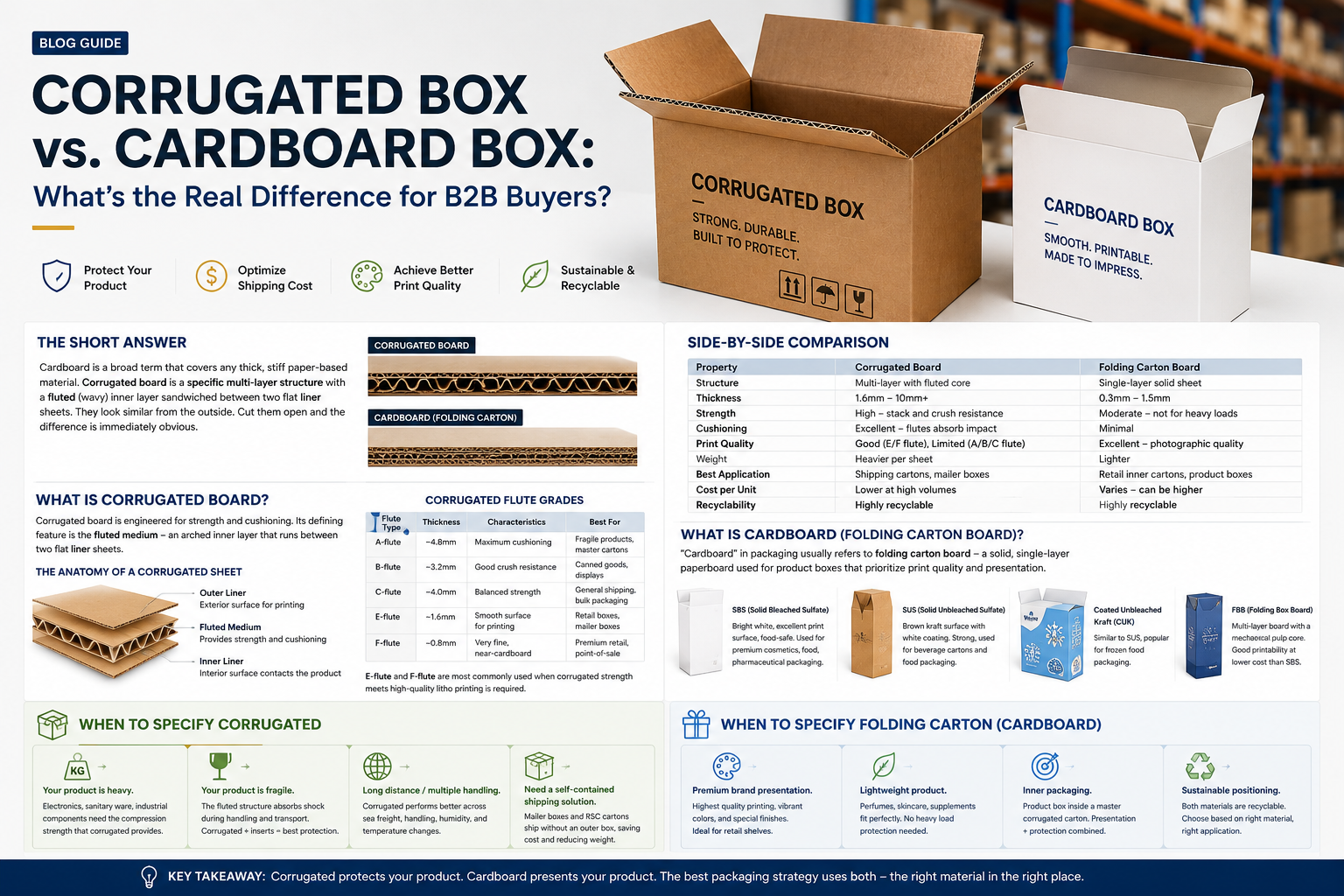
Cardboard is a broad term that refers to thick, stiff paper-based materials, such as folding carton board, chipboard, greyboard, and paperboard used for retail product boxes.
Corrugated board is a specific engineered structure made with a fluted, wave-shaped inner layer between two flat liner sheets. This is the material commonly used for shipping boxes, mailer boxes, and master cartons.
From the outside, the two materials may look similar. But when you cut them open, the difference is easy to see.
Corrugated board has a wavy inner layer. Cardboard or folding carton board is usually a solid single-layer sheet.
What Is Corrugated Board?
Corrugated board is designed for strength, cushioning, and protection during shipping.
Its most important feature is the fluted medium, which is the wave-shaped inner layer between two flat paper liners. This fluted structure helps the box resist compression, absorb impact, and protect products during storage and transport.
A standard corrugated sheet has three layers:
Outer liner: the exterior surface, usually used for printing
Fluted medium: the wavy inner layer that provides strength and cushioning
Inner liner: the inside surface that faces the product
This three-layer structure is called single-wall corrugated board.
For heavier or more fragile products, buyers may specify:
Double-wall corrugated board: five layers
Triple-wall corrugated board: seven layers
These structures provide higher stacking strength and better protection for demanding shipping conditions.
Common Corrugated Flute Grades
The flute size affects strength, cushioning, thickness, printability, and cost.
Flute Type | Approx. Thickness | Main Characteristics | Best For |
|---|---|---|---|
A-flute | ~4.8 mm | Maximum cushioning | Fragile products, master cartons |
B-flute | ~3.2 mm | Good crush resistance | Canned goods, displays |
C-flute | ~4.0 mm | Balanced strength | General shipping, bulk packaging |
E-flute | ~1.6 mm | Smooth surface for printing | Retail boxes, mailer boxes |
F-flute | ~0.8 mm | Very fine, near-cardboard appearance | Premium retail, point-of-sale packaging |
For branded packaging, E-flute and F-flute are especially popular because they combine corrugated strength with a smoother surface for high-quality printing.
That is why they are commonly used for:
Custom mailer boxes
Retail-ready packaging
E-commerce boxes
Premium product packaging
Printed corrugated boxes
What Is Cardboard or Folding Carton Board?
In packaging industry terms, “cardboard” usually refers to folding carton board.
This is a solid paperboard material used to make lightweight product boxes, especially where visual presentation and print quality are important.
Common applications include:
Cosmetic boxes
Pharmaceutical packaging
Food cartons
Cereal boxes
Small electronics boxes
Retail product packaging
Folding carton board is usually measured by gsm, meaning grams per square meter, or by caliper thickness. Common grades range from 250 gsm to 450 gsm.
Unlike corrugated board, folding carton board does not have a fluted inner layer. It is lighter, smoother, and better suited for detailed printing, but it does not provide the same level of structural protection.
Main Types of Folding Carton Board
SBS: Solid Bleached Sulfate
SBS is a bright white paperboard with an excellent print surface. It is often used for premium cosmetics, food packaging, pharmaceuticals, and high-quality retail boxes.
Best for:
Cosmetics
Food packaging
Pharmaceutical cartons
Premium printed boxes
SUS: Solid Unbleached Sulfate
SUS usually has a brown kraft surface with a white coating. It is strong and commonly used for food and beverage packaging.
Best for:
Beverage cartons
Food packaging
Durable retail cartons
CUK: Coated Unbleached Kraft
CUK is similar to SUS and is often used for frozen food and other food-related packaging applications.
Best for:
Frozen food packaging
Food cartons
Sustainable kraft-style packaging
FBB: Folding Box Board
FBB is a multi-layer board with a mechanical pulp core. It offers good printability at a lower cost than SBS.
Best for:
Retail cartons
Consumer goods packaging
Cost-sensitive printed boxes
Corrugated Box vs. Cardboard Box: Side-by-Side Comparison
Feature | Corrugated Board | Cardboard / Folding Carton Board |
|---|---|---|
Structure | Multi-layer with fluted core | Solid single-layer sheet |
Thickness | Around 1.6 mm to 10 mm+ | Around 0.3 mm to 1.5 mm |
Strength | High | Moderate |
Cushioning | Excellent | Minimal |
Print Quality | Good on E-flute and F-flute | Excellent |
Weight | Usually heavier | Usually lighter |
Best Use | Shipping cartons, mailer boxes, outer packaging | Retail product boxes, inner cartons |
Protection | Strong transit protection | Limited structural protection |
Cost | Cost-effective at scale | Varies by paper grade and finish |
Recyclability | Highly recyclable | Highly recyclable |
When Should You Use Corrugated Boxes?
Corrugated boxes are the right choice when the main goal is protection during shipping, storage, and handling.
You should specify corrugated packaging when:
Your Product Is Heavy
Products such as electronics assemblies, bathroom products, energy storage units, industrial components, and hardware require strong compression resistance.
A folding carton may collapse under stacking pressure, while corrugated board is designed to handle load-bearing conditions.
Your Product Is Fragile
For fragile products such as glass, ceramics, precision electronics, lighting, and high-value components, corrugated board provides better shock absorption.
For additional protection, corrugated boxes can be combined with:
Foam inserts
EPE pearl cotton
Molded trays
Corrugated dividers
Custom paperboard inserts
Your Product Ships Long Distances
Long-distance freight often involves multiple handling points, pallet stacking, temperature changes, and humidity exposure.
Corrugated board performs better under these demanding logistics conditions, especially for sea freight, warehouse distribution, and export packaging.
You Need a Self-Contained Shipping Box
Corrugated boxes can often be shipped directly without requiring an additional outer box.
Common self-contained corrugated formats include:
RSC shipping cartons
Mailer boxes
Full-overlap boxes
Retail-ready packaging
Heavy-duty master cartons
When Should You Use Cardboard or Folding Carton Boxes?
Cardboard or folding carton boxes are better when the main goal is retail presentation and print quality.
You should specify folding carton packaging when:
Your Product Is Displayed on a Retail Shelf
Retail packaging needs strong visual appeal. Folding carton board provides a smooth printing surface for sharp graphics, strong colors, and detailed product information.
It is especially useful for products that rely on shelf appeal.
Your Product Is Lightweight
Folding carton boxes are suitable for lightweight products that do not require heavy structural protection.
Examples include:
Cosmetics
Supplements
Small electronics accessories
Pharmaceuticals
Food items
Personal care products
Your Box Is an Inner Retail Carton
Many brands use a two-layer packaging system:
Folding carton for the inner retail product box
Corrugated carton for the outer shipping box
This allows the brand to balance premium shelf presentation with reliable freight protection.
You Need Premium Finishing
Finishing processes often perform better on the smooth surface of coated carton board.
Popular premium finishes include:
Matte lamination
Gloss lamination
Soft-touch lamination
Hot foil stamping
Spot UV
Embossing
Debossing
The Hybrid Option: Litho-Laminated Corrugated
For brands that need both strength and premium print quality, litho-laminated corrugated packaging is often the best solution.
In this process, a high-quality printed sheet is laminated onto corrugated board.
The result combines:
The structural strength of corrugated board
The print quality of folding carton board
Compatibility with premium finishes
Strong retail and shipping performance
Litho-laminated corrugated is commonly used for:
Retail-ready packaging
PDQ displays
Premium shipping boxes
Consumer electronics packaging
High-value branded packaging
How Material Choice Affects Total Cost
Many buyers compare only the unit price of the box. However, material choice affects the total cost in several ways.
Shipping Weight
Corrugated board is usually heavier than folding carton board. For air freight or courier shipments, box weight can affect total logistics cost.
Choosing a thinner flute, such as E-flute instead of B-flute, may reduce weight while still offering enough protection.
Product Damage Rate
Using the wrong packaging material can lead to damage claims, returns, replacements, and customer complaints.
Saving money on packaging by under-specifying the material can increase total cost in the long run.
Labor Efficiency
Some corrugated box structures, such as auto-lock bottom boxes, can be assembled faster than hand-folded cartons.
For high-volume production lines, faster assembly can reduce labor cost.
Retail Compliance
Large retailers may require specific packaging performance standards, including compression strength, stackability, and transit testing.
These requirements often favor corrugated packaging, especially for heavier or bulkier products.
What Huandao Manufactures
Huandao produces both corrugated packaging and folding carton packaging, allowing brands to source complete packaging systems from one supplier.
Corrugated Packaging Products
Huandao manufactures:
Mailer boxes
E-flute corrugated boxes
F-flute corrugated boxes
Shipping cartons
RSC boxes
Retail-ready packaging
PDQ displays
Heavy-duty double-wall cartons
Triple-wall master cartons
Folding Carton Products
Huandao also produces:
Color boxes
Cosmetic packaging cartons
Electronics retail boxes
Food packaging cartons
Gift packaging boxes
FSC-certified paperboard boxes
Integrated Packaging Solutions
For products that need both inner and outer packaging, Huandao can manufacture both layers under one roof.
This is useful for industries such as:
Consumer electronics
Bathroom products
Energy storage products
Personal care products
Retail consumer goods
Industrial components
An integrated supplier helps ensure:
Better structural fit
Consistent branding
More reliable color control
Shorter communication loops
Better quality control across packaging layers
Huandao has served clients including Panasonic, Kohler, Waterpik, Runner Group, and Solux.
Quick Decision Guide
Use this guide when deciding between corrugated and cardboard packaging.
Your Main Requirement | Recommended Packaging |
|---|---|
Protect product during freight | Corrugated board |
Display product on retail shelves | Folding carton board |
Combine strength and premium printing | Litho-laminated corrugated |
Ship D2C to consumers | E-flute or F-flute mailer box |
Package lightweight premium products | Folding carton or F-flute |
Ship heavy or fragile products | B-flute, C-flute, double-wall, or triple-wall corrugated |
Build a full packaging system | Inner folding carton + outer corrugated carton |
Frequently Asked Questions
Is Corrugated Board More Sustainable Than Cardboard?
Both corrugated board and folding carton board are recyclable.
Corrugated board often contains a higher percentage of recycled fiber, while both materials can be specified with FSC-certified paper if required.
For sustainability claims, buyers should ask suppliers for documentation, such as FSC certification or recycled content verification.
Can Corrugated Boxes Be Fully Printed in Color?
Yes. E-flute and F-flute corrugated boxes are suitable for high-quality full-color printing.
A-flute, B-flute, and C-flute corrugated boxes can also be printed, but they are more commonly printed using flexographic printing, which may have lower resolution than offset printing.
What Compression Strength Does My Shipping Box Need?
Compression strength depends on product weight, box size, pallet stacking height, freight route, and storage conditions.
A packaging engineering team can calculate the required ECT or BCT value and recommend the correct flute type and liner combination.
Can I Use the Same Design on Both Inner and Outer Packaging?
Yes. Many brands use consistent design elements across inner folding cartons and outer corrugated cartons.
With proper color management, Pantone or CMYK colors can be matched across different packaging substrates.
Get a Material Recommendation from Huandao
Not sure whether your product needs corrugated board, folding carton board, or a combination of both?
Send Huandao your product dimensions, weight, fragility level, shipping method, and target market. Our packaging engineers can recommend the right material, structure, printing method, and cost-effective packaging solution.
Request a Free Packaging Specification Consultation →
Download Our Material Selection Guide →
