

What Is CTP Plate Making? How It Improves Print Quality for Custom Packaging
If you have ever compared packaging samples from two suppliers and noticed that one looks sharper, cleaner, and more color-accurate, the difference may not only come from the printing press.
It may come from the pre-press workflow.
One of the most important technologies in professional packaging printing is CTP plate making, also known as Computer-to-Plate technology.
Although many buyers do not ask about CTP because it sounds like a technical production detail, it directly affects print resolution, sharpness, registration, color accuracy, and repeat order consistency.
This guide explains what CTP plate making is, how it works, why it matters for custom packaging, and how to evaluate whether a packaging supplier has real CTP capability.
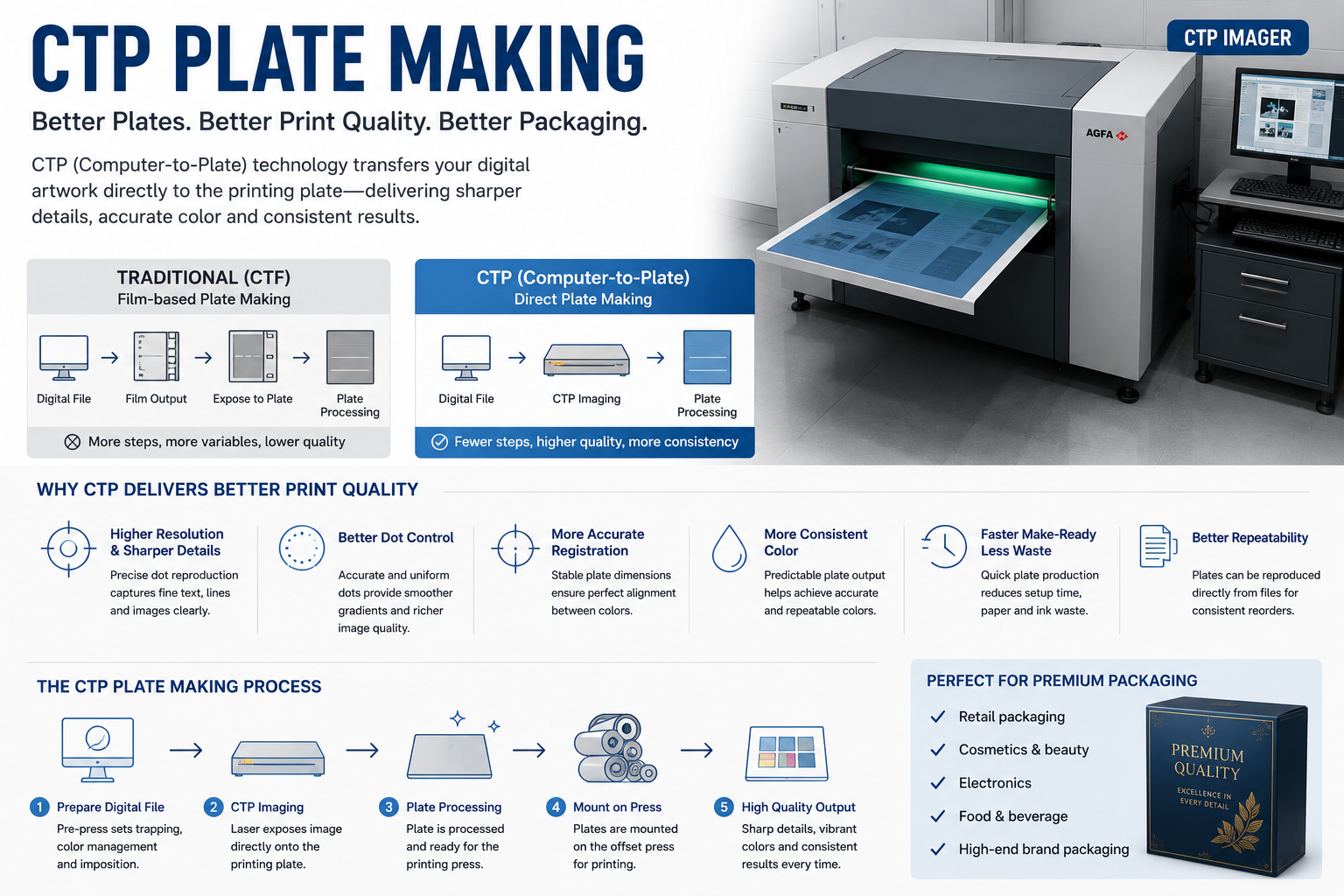
What Is CTP Plate Making?
CTP, or Computer-to-Plate, is a modern plate-making technology used in offset printing.
It transfers the digital artwork file directly onto a printing plate using a laser or LED imaging system.
This eliminates the older film-based plate-making process.
In simple terms:
Traditional process: digital file → film → printing plate
CTP process: digital file → printing plate
By removing the film step, CTP reduces quality loss, improves registration accuracy, and makes print results more consistent.
For custom packaging, this matters because the printing plate controls what the press reproduces. If the plate is sharp, accurate, and consistent, the final printed packaging has a much better chance of looking sharp, accurate, and consistent.
The Basics: How Offset Printing Works
To understand why CTP matters, it helps to understand the basics of offset printing.
Offset lithographic printing uses thin aluminum printing plates. These plates are usually around 0.15–0.3 mm thick and are wrapped around the plate cylinder of the printing press.
Each plate carries the image for one ink color.
For standard CMYK printing, four plates are used:
Cyan
Magenta
Yellow
Black
The plate is processed so that image areas attract ink and non-image areas repel ink.
During printing:
Ink is applied to the plate
The image transfers from the plate to a rubber blanket cylinder
The blanket transfers the image to paper or board
This indirect transfer is why the process is called offset printing.
The quality of the printed result depends heavily on the quality of the plate.
If the plate image is blurry, low-resolution, or poorly registered, those problems will appear on every printed sheet.
How Plates Were Made Before CTP
Before CTP became common, printing plates were usually made using a film-based process called CTF, or Computer-to-Film.
The workflow was:
Digital artwork was output to photographic film
The film was chemically developed
The film was placed over a photosensitive printing plate
UV light exposed the image onto the plate
The plate was chemically processed
This traditional method worked for many years, but it had several limitations.
Problems With Film-Based Plate Making
1. Quality Loss Across Two Generations
Film-based plate making converts the image twice:
First from digital artwork to film
Then from film to plate
Each step can introduce quality loss.
Fine details, small text, thin lines, and subtle gradients may become less sharp.
This is especially problematic for packaging designs with:
Small product information
Legal disclaimers
Barcodes
Fine-line graphics
High-resolution photography
Detailed product images
2. Less Precise Halftone Dots
Printed images are made from tiny halftone dots.
In film-based plate making, the dots can become softer and less uniform because of the film exposure and contact-copying process.
This affects:
Image sharpness
Tonal smoothness
Color accuracy
Gradient quality
Photographic reproduction
When dots are not formed precisely, the final printed packaging may look less clean and less premium.
3. Film Dimensional Instability
Photographic film can expand and contract with temperature and humidity.
This creates registration issues, especially in humid environments.
Registration means the precise alignment of different color plates.
If the plates do not align correctly, the printed result may show:
Color halos
Blurry image edges
Misaligned small text
Poor barcode clarity
Reduced sharpness
For packaging suppliers in humid regions, film instability can create real print quality problems.
4. More Process Steps and More Waste
Film-based plate making requires more manual handling, more chemical processing, and more consumable materials.
Every extra step creates more opportunity for error.
It also increases waste and slows down the pre-press process.
How CTP Plate Making Works
CTP removes the film stage completely.
The digital file is sent directly to a CTP imaging system, which writes the image onto the printing plate using laser or LED exposure.
The typical CTP workflow is:
The pre-press team prepares the digital print file
Color management, trapping, screening, and imposition are applied
The CTP system images the file directly onto a photosensitive plate
The plate is processed thermally or chemically
The finished plate is mounted on the offset press
Because the image is transferred directly from digital file to plate, the process is more accurate and more repeatable.
Main Types of CTP Technology
There are several types of CTP systems used in the printing industry.
For packaging buyers, the most important distinction is quality level.
1. Thermal CTP
Thermal CTP uses an infrared laser to image thermally sensitive plates.
It is widely used in professional commercial printing and packaging printing.
Advantages
High imaging precision
Excellent dot reproduction
Stable plate quality
Strong registration accuracy
Suitable for high-end packaging
Good support for advanced screening
Thermal CTP is the preferred option for premium packaging that requires fine detail, sharp images, and consistent color.
2. Violet Laser CTP
Violet CTP uses a violet laser to expose photopolymer plates.
It is slightly lower cost than thermal CTP and can deliver good results for many commercial printing applications.
Advantages
Good print quality
Lower equipment cost than thermal CTP
Suitable for mid-tier commercial printing
Faster than traditional film-based workflows
Violet CTP can be suitable for many packaging jobs, but thermal CTP is usually preferred for premium packaging output.
3. UV CTP
UV CTP uses UV light to image conventional plates.
It is generally lower in resolution and quality compared with thermal CTP.
Best For
UV CTP may be used in cost-sensitive or lower-end applications, but it is less common in quality-focused premium packaging production.
How CTP Improves Print Quality for Packaging
CTP improves print quality in several important ways.
For packaging buyers, these improvements are visible in sharper details, cleaner registration, better color stability, and more reliable repeat orders.
1. Higher Resolution and Sharper Detail
CTP systems can image plates at high resolution, often 1800–2400 dpi or higher.
This allows more precise reproduction of:
Small text
Barcodes
Fine-line graphics
Legal information
Product specifications
QR codes
Photographic details
Gradients and shadows
The halftone dots are sharper and more uniform, which helps the final printed packaging look cleaner and more professional.
For retail packaging, this can directly affect perceived product quality.
2. Better Dot Gain Control
Dot gain happens when ink dots spread during printing.
The printed dot becomes larger than the original dot on the plate.
Some dot gain is normal, but uncontrolled dot gain can cause:
Darker midtones
Muddy images
Color shifts
Poor contrast
Loss of fine detail
CTP creates more predictable dot shapes and sizes on the plate.
This makes dot gain easier to measure, predict, and control during printing.
Better dot gain control also supports more reliable color management and G7 calibration.
3. More Accurate Color Reproduction
Color accuracy depends on several factors, including ink, substrate, press condition, color management, and plate quality.
CTP improves plate accuracy, which supports better color reproduction.
When plate dots are precise and consistent, the press can reproduce CMYK separations more predictably.
This helps improve:
Pantone matching
CMYK color balance
Image reproduction
Gradient smoothness
Brand color consistency
CTP alone does not guarantee perfect color, but it is an important foundation for professional color control.
4. Better Plate-to-Plate Registration
Offset printing requires multiple plates to align accurately.
For CMYK printing, four plates must register with each other.
If registration is poor, the final print may show:
Colored edges around text
Blurry logos
Misaligned images
Unclear barcodes
Poor fine-line detail
CTP improves registration because the plate imaging process is digital, precise, and dimensionally stable.
There is no film expansion or contact exposure variation.
This is especially important for packaging with reversed white text, dark backgrounds, fine borders, and high-resolution product photography.
5. Faster Make-Ready and Less Waste
With CTP, plates can be produced quickly from finalized digital artwork.
This reduces pre-press time and helps the press reach production quality faster.
Benefits include:
Faster job setup
Fewer adjustment sheets
Less paper waste
Less ink waste
Shorter production preparation time
More consistent first-pass output
For packaging buyers, this can support faster lead times and more stable production scheduling.
6. Better Reproducibility for Repeat Orders
Many packaging buyers reorder the same packaging multiple times.
CTP helps because plates can be recreated directly from the same digital file.
This improves consistency across repeat production runs.
For brands managing long-term packaging programs, this helps maintain consistent:
Print sharpness
Registration
Color behavior
Small text clarity
Image quality
Compared with film-based systems, CTP provides stronger repeatability because the output is based on a controlled digital workflow.
CTP and Screening Technologies
CTP also supports advanced screening technologies.
Screening is the process that converts continuous-tone images into printable dot patterns.
Different screening methods affect image smoothness, gradients, and fine detail.
AM Screening
AM screening, or amplitude modulated screening, is the traditional halftone method.
Dots are arranged in a regular grid, and tone is controlled by changing dot size.
AM screening is widely used and works with both CTP and older film workflows.
However, it can sometimes produce moiré patterns in certain images or textures.
FM Screening
FM screening, also called stochastic screening, uses randomly distributed dots instead of a regular grid.
Tone is controlled by dot frequency rather than dot size.
Advantages
Smoother gradients
Reduced moiré risk
Better shadow detail
More natural photographic reproduction
FM screening requires high-precision CTP because the dots are very small and must be placed accurately.
Film-based systems cannot reproduce FM screening reliably.
Hybrid Screening
Hybrid screening combines AM and FM methods.
It may use AM screening in midtones and FM screening in highlights and shadows.
This approach can improve smoothness and detail while maintaining production stability.
For packaging designs with photography, gradients, skin tones, or fine shadows, FM or hybrid screening can produce better results.
Why Some Packaging Suppliers Still Use Film-Based Plate Making
CTP is common among higher-tier packaging printers, but some smaller or older suppliers still use film-based plate making.
The reasons are usually related to cost and customer requirements.
CTP equipment requires significant investment. A commercial thermal CTP system can cost hundreds of thousands of dollars.
Some suppliers continue using older film workflows because:
Their customer base is price-focused
Their jobs have simple graphics
Their print quality requirements are low
They have not invested in modern pre-press equipment
Buyers do not ask about CTP capability
For premium packaging, the difference between CTP and non-CTP output can be visible.
This is especially true for:
Retail color boxes
Premium electronics packaging
Cosmetic packaging
Litho-laminated corrugated
Packaging with photography
Packaging with small text or barcodes
Brand-critical color packaging
CTP Is Only One Part of a Professional Pre-Press Workflow
CTP is important, but it works best when combined with a complete professional pre-press system.
A strong packaging supplier should also have:
Professional RIP Software
A RIP, or Raster Image Processor, converts digital artwork into the bitmap image used by the CTP system.
Professional RIP software supports:
Color management
Trapping
Screening
Imposition
Ink control
Plate output consistency
Examples of professional RIP systems include Kodak Prinergy, Heidelberg Prinect, and AGFA Apogee.
Calibrated Color Management
CTP improves plate precision, but color still needs proper management.
A professional printer should use:
ICC profiles
G7 calibration
X-Rite color measurement
Certified proofing
Press-side measurement
Color tolerance standards
CTP without color calibration may produce sharp printing, but not necessarily accurate color.
High-Quality Presses and Inks
Even a perfect plate cannot compensate for a poorly maintained printing press.
Print quality also depends on:
Press condition
Ink quality
Blanket condition
Roller maintenance
Substrate quality
Operator skill
Press calibration
CTP performs best when combined with professional offset presses and stable production systems.
In-Line or Press-Side Quality Control
During production, the factory should measure whether the press is printing to specification.
This may include:
X-Rite eXact spectrophotometers
Control strip measurement
Closed-loop press control
Color density monitoring
Registration checks
Press sheet approval records
Together, these systems ensure that CTP precision translates into finished packaging quality.
How to Verify CTP Capability When Evaluating a Supplier
When auditing or qualifying a packaging supplier, buyers should not simply ask whether the supplier uses offset printing.
They should ask about the pre-press workflow.
Questions to Ask
Useful questions include:
Do you use CTP or film-based plate making?
What type of CTP system do you use?
Is it thermal CTP, violet CTP, or UV CTP?
What is the CTP equipment model and installation year?
What imaging resolution do you use?
What RIP software do you use?
Do you support FM or hybrid screening?
How do you calibrate the CTP system?
How do you manage plate output consistency?
Can you show print samples with fine-line detail and barcodes?
What to Check During a Factory Visit
If visiting the factory, ask to see the plate-making room.
A real CTP system is a large professional imaging unit connected to a plate processor.
Check for:
CTP imaging equipment
Plate processor
RIP workstation
Plate storage area
Calibration records
Workflow documentation
Plate inspection process
If the supplier claims to use CTP but cannot show the system, ask whether plate making is outsourced.
Outsourced CTP is not automatically a problem, but it adds coordination risk and may reduce control over lead time and quality.
Samples to Request
Ask for samples that reveal CTP quality clearly.
Good test samples include:
Reversed white text on dark backgrounds
6 pt small text
Fine-line borders
QR codes
Barcodes
Product photography
Smooth gradients
Metallic or dark color backgrounds
High-resolution retail graphics
These elements help buyers evaluate sharpness, registration, and dot control.
Huandao’s CTP and Pre-Press Infrastructure
Huandao uses thermal CTP across its offset production lines.
This supports the resolution, registration, and repeatability required for premium custom packaging.
Huandao’s pre-press infrastructure includes:
Thermal CTP Imaging
Thermal CTP imaging is used for offset printing plates.
It enables:
High-resolution plate output
Accurate registration
Stable dot reproduction
Better repeatability
Premium packaging print quality
Professional RIP Workflow
Huandao’s pre-press workflow includes professional RIP capability for:
Trapping
Imposition
Screening
Color management
Plate output control
This helps ensure that artwork is properly prepared before plate imaging.
X-Rite Calibrated Proofing
Huandao uses X-Rite calibrated proofing systems to produce certified contract proofs.
This helps ensure that client-approved proofs more accurately predict final press output.
Color-Critical Display Monitors
Huandao uses color-critical display monitors with X-Rite hardware calibration in the pre-press department.
This improves soft proofing accuracy and helps align screen review with printed output.
G7 Master Printer Certification
Huandao maintains G7 Master Printer certification.
G7 calibration depends on accurate dot reproduction, making CTP an important foundation for reliable color control.
2400 DPI Imaging Resolution
Huandao’s thermal CTP systems image at 2400 dpi, supporting fine halftone screens, stochastic screening, and hybrid screening for high-quality photographic reproduction.
Frequently Asked Questions
Is CTP Standard Across the Packaging Industry in China?
CTP is standard among larger, higher-tier packaging printers.
However, some smaller or older factories still use film-based plate making.
When evaluating a packaging supplier, always ask whether they use CTP rather than assuming it.
Does CTP Make a Visible Difference for Simple Designs?
For simple designs with solid colors and limited detail, the difference may be less obvious.
For packaging with photography, gradients, fine text, barcodes, or tight registration requirements, the difference is much more visible.
Does CTP Affect Packaging Cost?
CTP can reduce make-ready time and waste, but the impact on per-unit cost is usually small.
CTP should be considered a normal requirement for serious packaging printers, not a premium upgrade.
Buyers should be cautious of suppliers that still rely on film-based plate making for brand-critical packaging.
What Resolution Does Huandao’s CTP System Use?
Huandao’s thermal CTP systems image at 2400 dpi.
This supports fine halftone screens, stochastic screening, hybrid screening, and high-resolution packaging graphics.
Does CTP Matter for Flexographic Printing?
Yes.
Flexographic CTP also exists and provides similar advantages for flexo plate production.
For high-quality corrugated printing, flexo CTP can improve dot reproduction, consistency, and plate-making speed.
Work With a Packaging Supplier With Professional Pre-Press Capability
CTP plate making is one of the technical foundations of high-quality packaging printing.
It improves resolution, registration, dot control, color predictability, and repeat order consistency.
For buyers sourcing custom packaging, CTP capability is an important supplier evaluation point, especially for premium retail packaging, electronics packaging, cosmetics packaging, litho-laminated corrugated, and other print-sensitive applications.
Huandao’s thermal CTP systems, professional RIP workflow, X-Rite calibrated proofing, G7 Master calibration, and 2400 dpi plate imaging support the print quality required by brands that care about sharpness, consistency, and professional packaging presentation.
Learn More About Our Printing Equipment and Capabilities →
View Our Print Quality Samples →
Get a Custom Packaging Quote →
