

What Is G7 Certification in Printing? Why It Matters When Sourcing Packaging from China
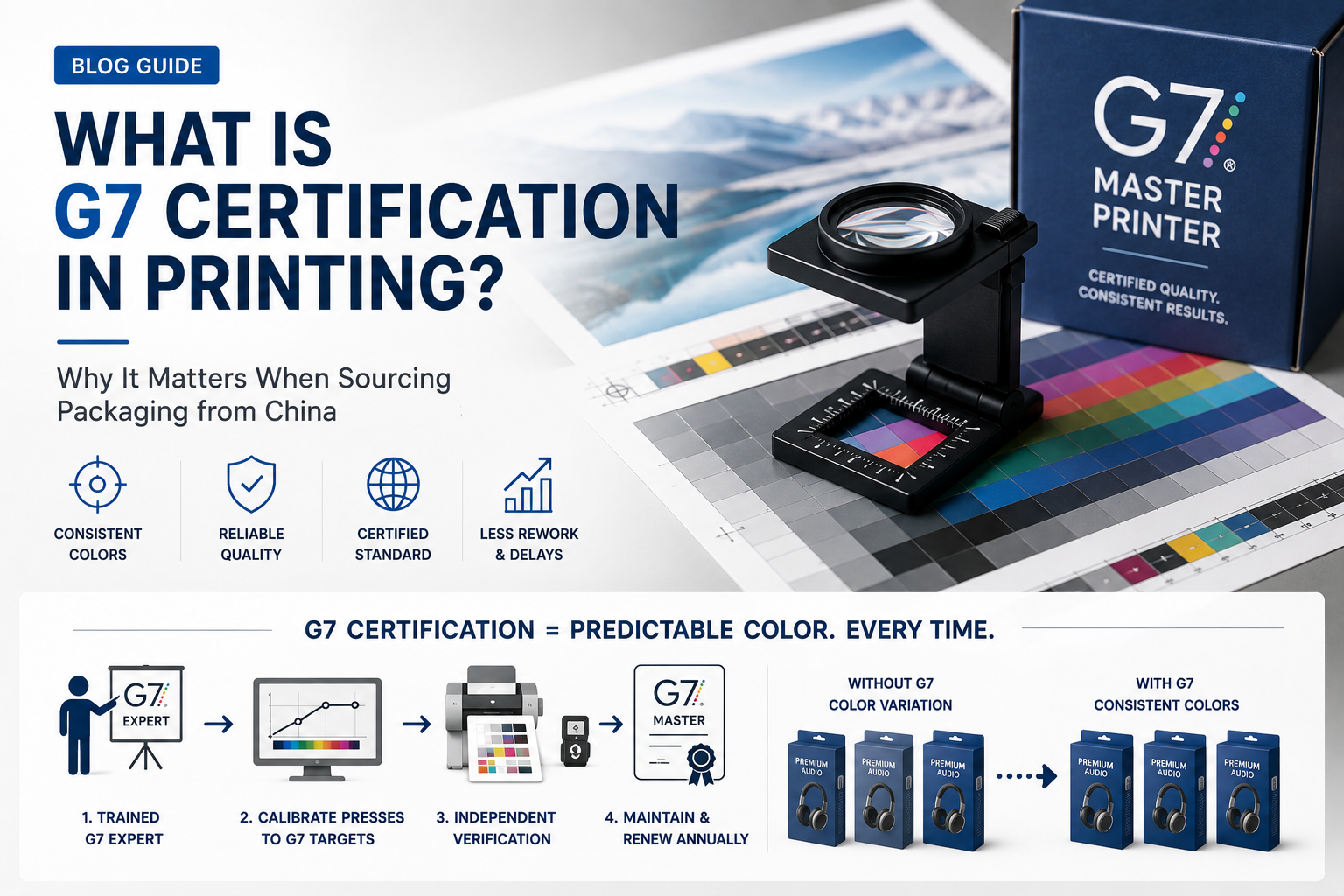
If you have ever received a packaging shipment where the colors looked different from the approved proof, you already understand why print color control matters.
Maybe the red on your packaging looked slightly too orange. Maybe two batches of the same box had different shades. Or maybe the color looked correct during sampling but shifted during mass production.
For brand managers, procurement teams, and product developers sourcing custom packaging from overseas manufacturers, this is a serious problem. Color inconsistency can affect shelf appearance, brand recognition, approval timelines, and customer trust.
That is exactly the problem G7 certification is designed to solve.
This guide explains what G7 certification means, how it works, and why it matters when sourcing printed packaging from China.
What Is G7 Certification?
G7 is a print calibration methodology and certification standard developed by IDEAlliance, a U.S.-based organization that sets technical standards for the graphic communications industry.
The name “G7” refers to seven gray values, from white to black, that are used as the foundation for press calibration.
The principle behind G7 is straightforward:
If every printing device can reproduce the same neutral gray balance, then color output becomes more visually consistent across different presses, substrates, inks, and production facilities.
In practice, G7 defines a specific set of tone response curves, also known as gray balance. A printing press must be calibrated to these curves to achieve consistent and predictable color output.
When a facility is G7 certified, it means its presses have been calibrated to this standard and independently verified by an IDEAlliance-approved expert.
Why Was G7 Developed?
Before standardized calibration methods like G7, print color consistency depended heavily on individual press settings, operator experience, and manual adjustment.
Printers often used a process called fingerprinting, where each press was characterized individually and assigned its own ICC profile.
This could work well for one specific press. But problems appeared when a job needed to be printed on another press, in another facility, or by another supplier.
Color could shift from one production run to another, even when the same artwork file and Pantone references were used.
For brand owners, this created several recurring problems.
Common Color Problems in Packaging Production
1. Brand Color Inconsistency
Brand colors need to remain consistent across every package, every batch, and every market.
If a red, blue, green, or skin tone shifts between production runs, the difference can be visible on the retail shelf.
For brands with multiple SKUs or seasonal packaging, inconsistent color weakens the overall brand presentation.
2. Longer Approval Cycles
Without a reliable color calibration standard, every new production run carries more color risk.
This often leads to:
More proofing rounds
More correction requests
Longer approval timelines
More back-and-forth with suppliers
Higher risk of production delays
For overseas packaging production, every correction cycle can add days or weeks to the timeline.
3. No Shared Color Standard
Without a common calibration language, the buyer and the factory may both believe the color is “correct,” even when the printed result does not match the approved standard.
G7 helps solve this issue by giving both sides a measurable and internationally recognized calibration baseline.
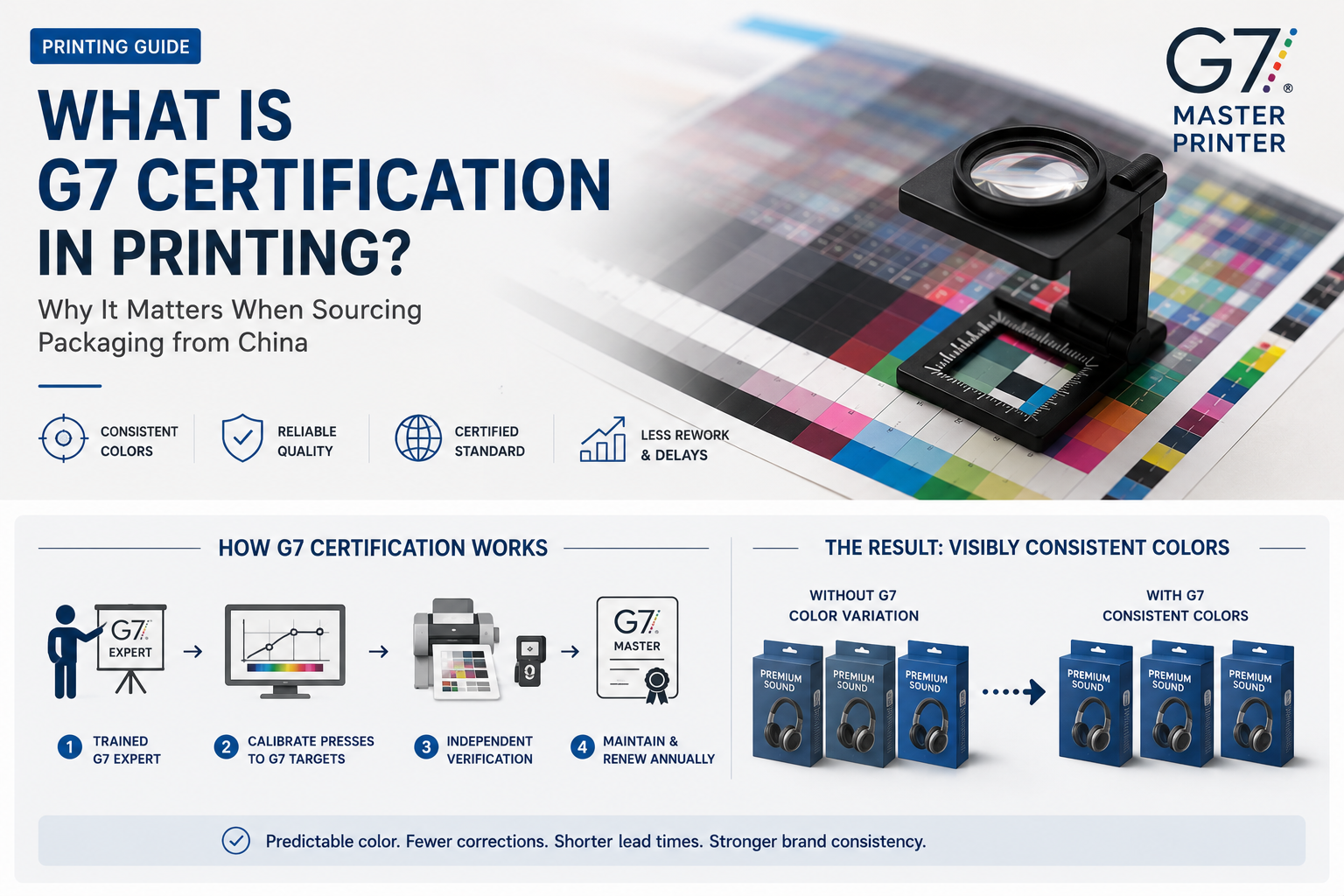
How G7 Certification Works
G7 certification is issued at the facility level by IDEAlliance.
To become certified, a printing facility must complete a structured calibration and verification process.
1. Train a G7 Expert
The facility must have a qualified press operator or color management specialist complete G7 Expert training and examination.
This person manages press calibration and color process control inside the facility.
2. Calibrate Presses to G7 Targets
The printing facility runs test prints and adjusts its tone response curves until the output matches G7 gray balance targets.
This process is known as G7 characterization.
3. Pass Independent Verification
An IDEAlliance-approved verifier measures printed output with a spectrophotometer and confirms that it meets G7 tolerance requirements.
This independent verification is what makes G7 different from a supplier simply claiming that they have “good color control.”
4. Maintain Certification
G7 certification is not a one-time achievement.
Certified facilities must maintain compliance and renew certification through ongoing verification.
This ensures that color control remains part of the production system, not just a temporary setup for one audit.
Levels of G7 Certification
There are several levels of G7 certification, each representing a different degree of compliance.
G7 Level | What It Means |
|---|---|
G7 Calibration | Basic gray balance calibration for specific press configurations |
G7 Targeted | Gray balance calibration plus alignment to a specific print condition |
G7 Master | Highest level, covering gray balance and colorimetric accuracy across the tonal range |
G7 Master Printer certification is the highest level of G7 recognition.
Huandao holds G7 Master Printer certification across its offset printing production lines.
What G7 Certification Means for Packaging Buyers
For brands sourcing printed packaging, G7 certification offers practical benefits that directly affect quality, timeline, and supplier reliability.
1. More Predictable Color Across Production Runs
A G7-calibrated press can reproduce brand colors more consistently from one production run to the next.
This is especially important for:
Replenishment orders
Seasonal packaging
Multi-SKU product lines
Retail display packaging
Brand-critical color systems
When the press is calibrated to the same standard, the final packaging becomes more predictable across repeated orders.
2. Better Consistency Across Multiple Facilities
Global brands often work with more than one packaging supplier or production facility.
Without a common standard, each factory may interpret and reproduce colors differently.
G7 certification creates a shared calibration baseline, making color transfer between facilities more predictable.
This is valuable when brands need consistent packaging across different regions, suppliers, or production schedules.
3. Fewer Color Approval Iterations
Color correction can delay packaging production.
A G7-certified facility reduces the risk that the first production proof will be far from the approved target.
This can help reduce:
Repeated proofing
Artwork correction loops
Delayed approvals
Production uncertainty
Last-minute color disputes
For brand-critical colors, such as specific reds, blues, beauty tones, or product photography, this can make the approval process much more efficient.
4. A Verifiable Supplier Standard
Many suppliers say they can control color well.
G7 certification gives buyers something more concrete: an independently verified standard that can be requested, documented, and referenced in supplier agreements.
Packaging buyers can ask for:
Current G7 certification documents
G7 certification level
Press calibration process
Color measurement equipment
Color tolerance standards
This makes supplier evaluation more objective.
G7 vs. Other Print Color Standards
G7 is often mentioned together with Pantone, ICC profiles, GMI, GRACoL, and SWOP. These terms are related, but they are not the same.
G7 and Pantone
Pantone is a color specification system. It defines what a specific color should look like.
For example, a Pantone reference tells the printer the target color.
G7 is a calibration method. It helps the printing press reproduce that target color more consistently.
In simple terms:
Pantone defines the color target
G7 helps the press hit the target reliably
G7 and ICC Profiles
ICC profiles describe how a specific device reproduces color.
A monitor, scanner, proofing system, or printing press can each have its own ICC profile.
G7 calibration helps create more consistent press behavior, which makes ICC profiles more accurate and more transferable.
G7 and GMI
GMI, or Graphic Measure International, is a separate certification that evaluates a facility’s broader print quality management system.
GMI looks at color management, process control, consistency, and operational quality.
G7 is often a component of GMI compliance.
A facility holding both G7 Master and GMI certification has demonstrated both technical calibration capability and broader quality management discipline.
G7 and GRACoL / SWOP
GRACoL and SWOP are reference print conditions that define target color characteristics for specific print applications.
G7 Targeted certification means a press has been calibrated to match a specific reference condition, such as GRACoL or SWOP.
Why G7 Certification Is Rare Among Chinese Packaging Manufacturers
China is one of the world’s largest packaging manufacturing markets. However, G7 certification is still not common among many Chinese packaging suppliers.
There are several reasons.
It Requires Real Investment
G7 certification requires more than basic printing equipment.
A facility needs:
Spectrophotometers
Densitometers
Color management software
Trained color specialists
Calibration time
Annual verification
Process discipline
For factories competing mainly on price, this investment may not be prioritized.
Many Customers Do Not Ask for It
Historically, many domestic and lower-margin export customers did not require G7 certification.
If customers do not specify G7, many factories have little commercial incentive to invest in certification.
Color Management Requires Technical Expertise
G7 calibration requires trained color professionals and disciplined production control.
Many mid-tier printing factories may have experienced operators, but not a fully developed color management system.
For international brands sourcing packaging from China, G7 certification is therefore a meaningful differentiator.
It signals that a packaging manufacturer has invested in international print quality standards, not just basic production capacity.
How Huandao Implements G7 Color Management
Huandao holds G7 Master Printer certification and maintains it through annual verification.
Its color management system includes equipment, trained staff, proofing procedures, and press-side process control.
X-Rite Color Measurement System
Huandao uses X-Rite spectrophotometry equipment for press-side color measurement.
This helps verify gray balance and color output before and during production.
Instead of relying only on visual judgment, production color is measured against approved standards.
Certified G7 Experts
Huandao’s color management team includes trained G7 Experts who oversee calibration and color-critical production.
This helps ensure that G7 is applied as an operating system, not just as a certificate on the wall.
Certified Color Proofing
Before mass production begins, Huandao produces a calibrated color proof.
This proof is aligned with the same G7 standard used by the production press, allowing buyers to approve a more accurate representation of final production output.
Closed-Loop Press Control
Huandao uses KBA offset printing presses with closed-loop color control.
This system helps monitor and adjust ink density during production, supporting consistent output across long print runs.
Questions to Ask Your Packaging Supplier About Color Management
When evaluating a packaging supplier, do not rely only on general claims like “we have good printing quality.”
Ask specific questions that reveal whether the supplier has a real color management system.
Useful questions include:
Are you currently G7 certified?
What level of G7 certification do you hold?
Can you provide current certification documentation?
Who is your G7 Expert?
What color measurement equipment do you use?
How do you create and approve color proofs?
How do you verify color during production?
What tolerance standard do you use for color deviation?
What happens if production exceeds the tolerance?
Do you also hold GMI certification?
A qualified supplier should be able to answer these questions with specific, documented responses.
Vague answers are a warning sign.
Frequently Asked Questions
Does G7 Certification Guarantee Perfect Color Every Time?
No certification can eliminate all print variation.
However, G7 certification dramatically improves color predictability by calibrating presses to a defined standard and keeping deviations within measurable tolerances.
The key benefit is that color differences become controlled and measurable instead of random and unpredictable.
Can I Specify G7 Compliance in My Packaging Brief?
Yes.
Buyers can specify G7 Master certified production facility in supplier requirements and request current certification documentation before placing an order.
This is especially useful for brand-critical packaging and repeat production programs.
Is G7 Relevant for Flexographic Printing on Corrugated?
G7 was originally developed for offset lithographic printing and is most commonly applied in that context.
For high-quality corrugated packaging using E-flute or F-flute, G7-calibrated offset printing is often the recommended approach.
For basic flexographic printing on corrugated, related but different process controls may also be used.
How Often Does G7 Certification Need to Be Renewed?
G7 Master certification is renewed annually through IDEAlliance’s verification process.
Buyers should always ask for current certification documentation rather than relying on an outdated certificate.
What Is the Difference Between G7 and Good Pantone Matching?
Pantone matching is the result buyers want.
G7 calibration is the process that helps achieve that result consistently.
A supplier may match a Pantone color once through manual adjustment, but G7 certification indicates that the press is systematically calibrated to produce reliable color output over time.
Work With a G7 Master Certified Packaging Manufacturer
If your brand requires consistent packaging color, predictable approval cycles, and internationally verified print standards, working with a G7-certified packaging manufacturer can reduce risk.
Huandao is one of the packaging manufacturers in China with G7 Master Printer certification. With G7 calibration, X-Rite color measurement, KBA offset printing presses, and certified proofing, Huandao helps brands achieve consistent printed packaging across production runs.
Request a Color Consistency Consultation →
View Our Certifications →
Get a Custom Packaging Quote →
