

Custom Retail-Ready Packaging (RRP) for Consumer Electronics: A Buyer’s Guide
Walk into any large electronics retailer and you will notice one thing: successful brands do not rely on product quality alone.
They also use packaging that works at retail.
Good retail-ready packaging organizes shelf space, communicates product value quickly, helps store staff replenish products efficiently, and protects the product through the full supply chain.
For consumer electronics brands sourcing from Asia, retail-ready packaging is one of the most important packaging decisions to get right.
This guide explains what retail-ready packaging is, why consumer electronics brands need it, the main RRP formats available, and how to work with a supplier to develop packaging that protects, displays, and sells.
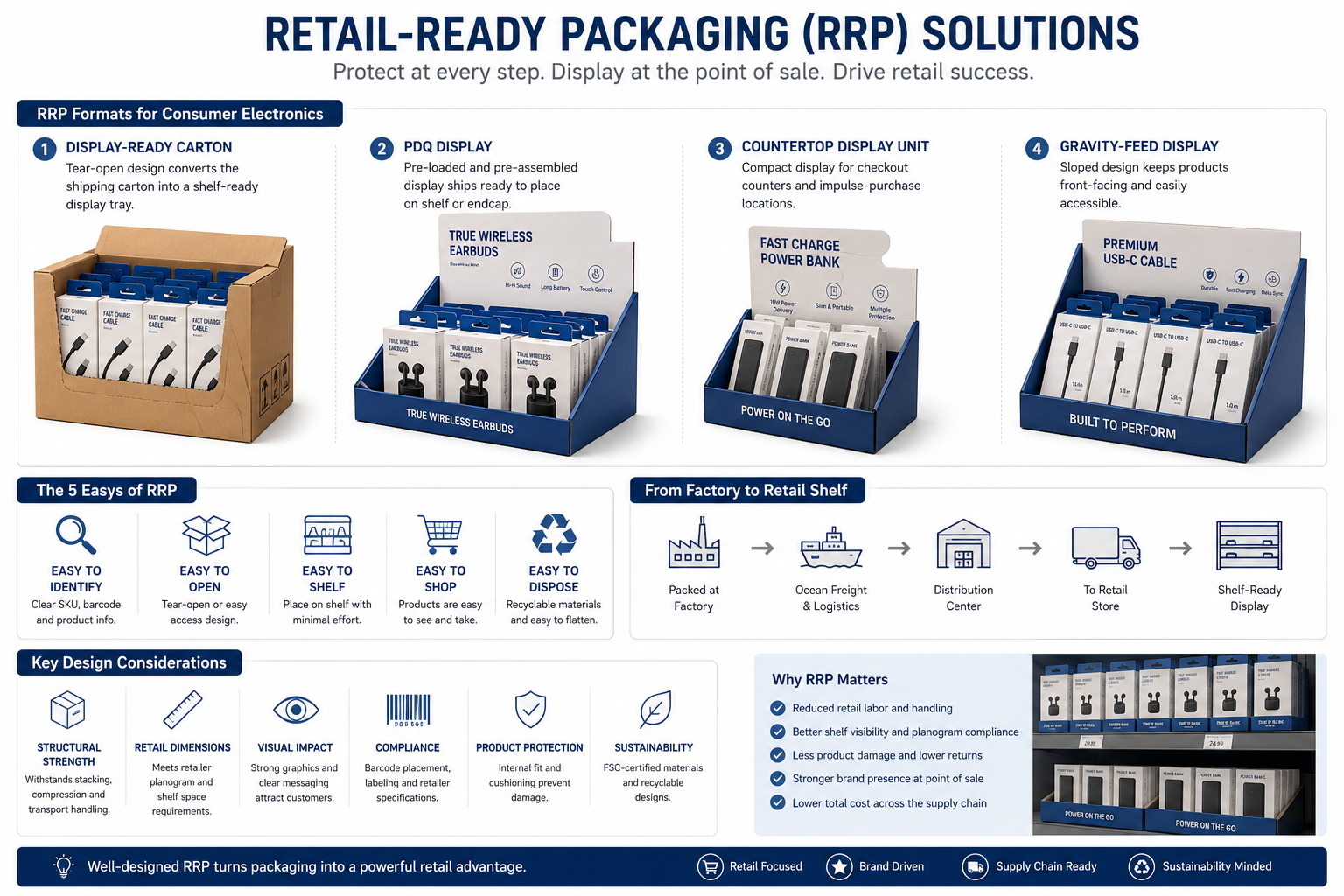
What Is Retail-Ready Packaging?
Retail-ready packaging, often shortened to RRP, refers to packaging designed to perform two functions at the same time:
Protect the product through the supply chain
Display the product effectively at the point of sale
Retail-ready packaging is also called:
Shelf-ready packaging
SRP packaging
Retail display packaging
Display-ready packaging
PDQ display packaging
The key feature of RRP is that it can move from warehouse to retail shelf as one unit.
Instead of retail staff opening a master carton and placing individual products one by one, the outer case can be opened, converted, or placed directly onto the shelf as a display tray.
For consumer electronics, RRP is commonly used for:
Cables
Chargers
Power banks
Earphones
Smart home devices
Phone accessories
Screen protectors
Small electronics accessories
Seasonal or promotional tech products
Why Consumer Electronics Brands Need RRP
Retail-ready packaging is important because it solves practical problems for both retailers and brands.
Retailers need faster stocking, cleaner shelves, and better planogram compliance.
Brands need stronger presentation, better visibility, and more control over how products appear at the point of sale.
The Retailer Perspective
1. Labor Efficiency
Retail staff time is expensive.
If a staff member can place one pre-configured display tray onto a shelf instead of unpacking and arranging 12 individual products, the time saving is significant.
This is one reason many major retailers prefer or require retail-ready packaging for certain categories.
RRP helps reduce:
Shelf-stocking time
Product handling
Repackaging work
Stockroom preparation
Merchandising inconsistency
2. Planogram Compliance
Retailers manage shelf space using planograms.
A planogram defines exactly where each product should sit, how many facings it should have, and how it should be presented.
RRP makes planogram compliance easier because the display tray is designed with fixed dimensions, product orientation, and unit count.
This reduces the chance that products are placed incorrectly on shelf.
3. Better Stock Visibility
Open-front RRP trays allow staff and customers to see available stock quickly.
Store staff can identify low stock without opening cartons or counting individual units.
This helps reduce out-of-stock situations and improves shelf management.
4. Reduced Product Damage
When products are handled individually during stocking, the risk of cosmetic damage increases.
Boxes can be dropped, scuffed, bent, or misplaced.
With RRP, the complete tray is moved and placed as one unit, reducing individual handling and helping protect the product packaging.
The Brand Perspective
1. Better Product Presentation
A well-designed RRP tray presents products in the correct position, angle, and spacing.
This gives the brand more control over the retail shelf experience.
Instead of relying on store staff to arrange products neatly, the packaging structure itself controls the presentation.
2. Stronger Brand Differentiation
Consumer electronics is a highly competitive retail category.
At the moment of purchase, customers often compare several similar products side by side.
RRP gives brands a larger visual area than a single retail box, helping communicate:
Product benefits
Brand identity
Technical features
Promotional messages
Premium positioning
3. Retail Compliance
Many major retailers have moved from preferring RRP to requiring it for certain categories.
If your brand already has RRP-ready packaging, it is easier to respond to retailer requirements without redesigning packaging at the last minute.
This is especially important for new product launches and retail expansion.
4. Lower Total Packaging Cost
Retail-ready packaging may sometimes reduce total cost.
A well-designed RRP structure can combine the outer shipping case and retail display into one format.
This can reduce:
Secondary packaging
Retail handling
Damage rates
Stocking labor
Rework and repacking
The unit packaging cost may be higher than a basic carton, but the total supply chain cost can be lower.
Main RRP Formats for Consumer Electronics
Retail-ready packaging comes in several formats. The right choice depends on product type, retail channel, unit count, shelf space, and brand presentation requirements.
1. Display-Ready Carton
A display-ready carton, or DRC, is one of the most common RRP formats for consumer electronics.
It starts as a corrugated master carton. The carton includes perforated tear panels on the front, top, or side.
When the retail staff removes the perforated panel, the carton converts into an open display tray that can sit directly on the shelf.
How It Works
The display-ready carton is:
Packed at the factory
Palletized and shipped
Received at the distribution center
Sent to the retail store
Opened by tearing away the perforated panel
Placed directly onto the shelf
Best For
Display-ready cartons are suitable for:
Cables
Chargers
Power banks
Earphones
Smart home devices
Small electronics accessories
Products displayed in 6–12 units per tray
Design Considerations
A good display-ready carton should have:
Clean tear perforations
Stable open-tray structure
Correct product orientation
Shelf-ready dimensions
Strong enough board for shipping and display
Visible product facing after opening
The perforation must be easy to open but not so weak that the carton fails during transport.
2. PDQ Display
PDQ stands for “Pretty Damn Quick.”
A PDQ display is a pre-loaded, pre-assembled retail display that can be placed directly on a counter, shelf, or endcap.
The goal is fast retail deployment with minimal store labor.
PDQ displays are usually made from printed corrugated board and shipped with products already loaded inside.
Best For
PDQ displays are suitable for:
High-velocity SKUs
Checkout displays
Endcap promotions
Seasonal electronics
Product launches
Tech accessories
Promotional bundles
Design Considerations
A PDQ display must be engineered for both shipping and in-store display.
Important factors include:
Product weight
Tray stability
Customer viewing angle
Retailer display rules
Outer shipper protection
Graphic visibility
Shelf or counter footprint
The display tray must remain stable when fully loaded and should not collapse or tilt during retail use.
3. Countertop Display Unit
A countertop display unit, or CDU, is a smaller display designed for checkout counters, service desks, small stores, and impulse-purchase locations.
CDUs often hold 6–24 units of small products.
For electronics accessories, CDUs are often made from folding carton board such as SBS because it offers high-quality print and a cleaner retail appearance.
Best For
Countertop display units are suitable for:
Phone cases
Screen protectors
Charging cables
Earbuds
Travel chargers
Small tech accessories
Add-on purchase products
Design Considerations
CDUs should be compact, visually clear, and easy for customers to shop.
A strong CDU design should include:
Clear product visibility
Strong brand message
Easy product removal
Stable base
High-quality print
Small retail footprint
4. Gravity-Feed Display
A gravity-feed display uses a sloped or tiered structure that allows products to move forward automatically as customers remove the front units.
This keeps the display tidy and helps products stay front-facing without constant staff adjustment.
Best For
Gravity-feed displays are suitable for:
High-velocity accessories
Checkout displays
Small boxed electronics
Refill-style retail programs
Products requiring constant front-facing
Gravity-feed structures are more common in larger display units but can also be adapted for electronics accessories.
The Five Easys of Retail-Ready Packaging
Many major retailers evaluate RRP using the Five Easys framework.
This framework helps determine whether packaging is truly retail-ready.
1. Easy to Identify
Retail staff must be able to identify the product without opening the case.
The outer shipper should clearly show:
Product name
SKU
Barcode
Quantity
Product image or description
Shelf location or planogram information
Handling instructions
This helps stockroom staff place the correct product in the correct location.
2. Easy to Open
The package should be easy to open without knives, tools, or excessive force.
Opening methods may include:
Tear strips
Perforated panels
Removable front sections
Pull tabs
The opening process should not damage the inner product packaging or the display tray.
3. Easy to Shelf
Once opened, the tray or display should be ready to place on shelf with little or no adjustment.
The package should already have:
Correct product orientation
Correct unit count
Correct facing direction
Retailer-approved dimensions
Stable display structure
This improves stocking speed and reduces merchandising errors.
4. Easy to Shop
Customers should be able to see, select, and remove the product easily.
A good RRP design should avoid:
Products packed too tightly
Poor product visibility
Unclear product information
Displays that collapse when one item is removed
Structures that block product access
The display must support both presentation and usability.
5. Easy to Dispose
Retailers increasingly expect RRP to be recyclable and easy to flatten after use.
An empty display tray should be:
Easy to collapse
Easy to recycle
Free from unnecessary mixed materials
Made from recyclable corrugated or paperboard when possible
FSC-certified corrugated is often preferred for retail-ready packaging.
Print and Presentation Quality for Electronics RRP
Consumer electronics is visually competitive.
Packaging must communicate technical value, brand credibility, and product quality quickly.
For many products, the RRP tray or display may be the first thing the customer notices.
Litho-Laminated Corrugated
For retail-ready packaging with strong visual requirements, litho-laminated corrugated is often the preferred solution.
This process prints a high-quality sheet using offset lithographic printing and then laminates it onto corrugated board.
The result is packaging that combines:
Corrugated strength
Retail-quality graphics
High-resolution product photography
Rich color saturation
Fine-line detail
Better shelf impact
Litho-laminated corrugated is commonly used for:
PDQ displays
Premium display-ready cartons
Retail trays
Promotional electronics displays
Branded shelf-ready packaging
Finishing Options for RRP
RRP can use many of the same finishing options as retail cartons.
Common finishing options include:
Matte lamination
Gloss lamination
Spot UV
Hot foil stamping
Embossing
Debossing
For electronics RRP, gloss lamination is often used for vivid product imagery, while matte lamination can create a more premium and modern feel.
Spot UV can highlight logos, product images, or key selling points.
Color Consistency Across Retail Markets
Consumer electronics brands often distribute the same product through different retailers, regions, and production schedules.
A display in one market should match the same display in another market.
Color inconsistency can weaken brand identity and make retail displays look unprofessional.
Consistent color is especially important for:
Brand colors
Product photography
Multi-SKU ranges
Promotional campaigns
Replenishment orders
Global retail programs
Huandao’s G7 Master and GMI-certified printing system helps ensure Pantone and CMYK colors are reproduced consistently across production runs.
Structural Engineering for Electronics RRP
Retail-ready packaging must perform as both a shipping carton and a display structure.
That means it needs stronger structural engineering than a basic retail carton.
1. Shelf Load Bearing
A display-ready tray may sit on the shelf for days or weeks while holding product weight.
The tray must maintain its shape and strength over time.
If the structure weakens, bends, or collapses, the retail display looks poor and may fail compliance checks.
2. Stacking Performance During Transit
Before it becomes a retail display, RRP must survive transport as a shipping carton.
It must withstand stacking during:
Pallet storage
Warehouse handling
Ocean freight
Truck transport
Retail distribution
Perforations and tear panels must be engineered carefully.
They need to open cleanly at retail but remain strong enough during shipping.
3. Open-Front Stability
Many RRP trays use an open-front design after the front panel is removed.
The remaining structure must stay stable even when products are removed unevenly.
To improve open-front stability, the design may need:
Reinforced side walls
Internal support panels
Folded locking structures
Gussets
Stronger board grades
4. Retailer Dimensional Compliance
Major retailers often publish packaging requirements for retail-ready displays.
These may include:
Shelf depth limits
Display tray height
Facing count
Maximum overhang
Barcode position
Peg-hole requirements
Recyclability requirements
FSC material requirements
ISTA testing standards
A packaging supplier should review retailer requirements before starting structural design.
Huandao has experience designing to requirements from Walmart, Target, Home Depot, Best Buy, Amazon, and other major retail channels.
The RRP Development Process
Developing retail-ready packaging requires planning, sampling, testing, and approval.
For brands developing RRP for the first time, the process usually includes the following stages.
Stage 1: Brief and Specification
The first step is to define the packaging requirements.
The brief should include:
Product dimensions
Product weight
Unit count per tray
Retailer requirements
Planogram specifications
Shelf dimensions
Barcode requirements
Brand guidelines
Print requirements
Sustainability requirements
This stage determines the structure, material, print method, and retail compliance direction.
Stage 2: Structural Design and CAD
The packaging supplier creates a structural design and die-line.
This includes:
Carton dimensions
Perforation placement
Tear panel structure
Product orientation
Stacking strength
Display tray design
Retail shelf fit
For PDQ displays, a 3D rendering can help visualize the final retail display before physical sampling.
Stage 3: Physical Sample Production
The supplier produces an unprinted structural sample, often called a white sample.
This sample is used to test:
Product fit
Opening function
Shelf placement
Tray stability
Unit orientation
Basic stacking performance
White samples allow brands to confirm the structure before investing in final print and tooling.
Stage 4: Print Design and Color Proofing
After the structure is approved, brand artwork is applied to the die-line.
Color proofs are produced for review and approval.
For retail-ready packaging, color proofing is important because the display will be visible at point of sale.
Stage 5: Pre-Production Printed Sample
A fully printed and finished sample is produced before mass production.
This sample should represent the final production result as closely as possible.
It may be used for:
Internal approval
Retailer approval
Photography
Planogram testing
Sales presentation
Final packaging validation
Stage 6: Full Production
After final approval, full production begins.
For litho-laminated RRP, production typically includes:
Offset printing
Lamination to corrugated board
Die cutting
Folding
Gluing
Packing
Final inspection
After approval, standard production time is often 10–15 business days, depending on order size and complexity.
How Huandao Supports Electronics RRP
Huandao designs and manufactures retail-ready packaging for consumer electronics brands and manufacturers supplying U.S., European, and global retail channels.
Huandao’s RRP capability includes:
Structural Design
Huandao provides in-house die-line engineering and structural design for RRP formats.
This includes experience with:
Display-ready cartons
PDQ displays
Countertop display units
Open-front shelf trays
Retail display cartons
Product-and-display integrated packaging
Retailer Specification Compliance
Huandao has experience designing packaging for major retail requirements, including:
Walmart
Target
Home Depot
Best Buy
Amazon
Retailer requirements may include the Five Easys, FSC materials, ISTA testing, planogram compliance, and dimensional standards.
Litho-Laminated Corrugated Production
Huandao produces E-flute and F-flute corrugated with offset litho-lamination for retail-quality graphics.
This is suitable for:
Electronics accessories
Smart home products
Power banks
Chargers
Retail trays
Promotional displays
Premium display-ready cartons
Color Management
Huandao holds G7 Master and GMI certifications.
This helps ensure approved Pantone and CMYK colors remain consistent across production runs and retail market variants.
In-House Sample Room
Huandao can produce physical samples in-house, enabling faster iteration before tooling and full production.
White samples and printed pre-production samples help brands test fit, function, and appearance before committing to production.
Integrated Supply
Huandao can provide a complete RRP packaging system, including:
RRP outer case
Inner retail box
Foam insert
Tray insert
Labels
Printed collateral
Retail display components
This reduces supplier coordination risk and improves dimensional consistency across the full packaging system.
Frequently Asked Questions
What Is the Minimum Order Quantity for Custom RRP?
For litho-laminated corrugated RRP, standard MOQ is typically around 1,000–2,000 units, depending on case size and print complexity.
For display-ready cartons without litho lamination, lower MOQs may be available depending on structure and production method.
Can I Get a Structural Sample Before Print Tooling?
Yes.
Huandao can produce unprinted structural samples for fit and function testing before finalizing print artwork or die-cut tooling.
This is a standard part of the RRP development process.
Do You Have Experience With Walmart Packaging Specifications?
Yes.
Huandao has experience designing to Walmart supplier packaging requirements, including FSC requirements, Five Easys compliance, and ISTA testing requirements.
Buyers should provide the current retailer specification document during the briefing stage.
How Do You Ensure Brand Color Consistency Across Production Runs?
Huandao uses a G7 Master and GMI-certified color management system.
Approved Pantone or CMYK colors are reproduced within defined tolerances across production runs.
Pre-production color proofs are produced and approved before full production.
Can the Same Package Be Used for Multiple Retail Channels?
Sometimes.
It depends on the dimensional and compliance requirements of each retailer.
In some cases, one design can be used across multiple channels. In other cases, minor adjustments may be needed, such as different perforation placement, outer dimensions, or label positions.
Huandao can advise whether one structure can meet multiple channel requirements or whether separate packaging SKUs are recommended.
Source Custom Retail-Ready Packaging from Huandao
Retail-ready packaging helps consumer electronics brands protect products, improve shelf presentation, reduce retail labor, and meet major retailer requirements.
For products sold through electronics retailers, big-box stores, home improvement channels, and promotional displays, RRP can improve both operational efficiency and point-of-sale impact.
Huandao supports consumer electronics brands with custom RRP design, litho-laminated corrugated production, in-house sampling, retailer compliance experience, G7/GMI color management, and integrated packaging supply.
Whether you need a display-ready carton, PDQ display, countertop unit, or open-front shelf tray, Huandao can help develop a retail-ready packaging solution that works from factory to shelf.
View Our Electronics Packaging Portfolio →
Request an RRP Consultation →
Get a Custom Packaging Quote →
