

Blister packaging is one of the most widely used packaging formats for consumer goods, pharmaceuticals, electronics accessories, hardware, personal care products, and small retail items.
However, for B2B buyers, blister packaging is also one of the most commonly misunderstood formats. Many buyers choose it simply because it is familiar, without evaluating whether it is truly the best option for their product, target market, retail channel, or cost structure.
This guide explains what blister packaging is, the main types available, which materials to choose, when to use it, and what cost factors buyers should consider before placing an order.
What Is Blister Packaging?
Blister packaging is a type of pre-formed plastic packaging that creates a shaped cavity, or “blister,” to hold a specific product.
The clear plastic shell is usually sealed to a backing material such as paperboard, foil, or another plastic sheet. This structure allows the product to remain visible while also being protected from handling, moisture, dust, and retail damage.
Blister packaging is commonly used because it can:
Display the product clearly at point of purchase
Protect the product from dust, moisture, and handling damage
Improve theft deterrence and tamper evidence
Provide space for printed product information
Create a standardized retail display format
Support peg-hole and shelf-ready retail layouts
For many retail products, blister packaging offers the right balance between visibility, protection, branding, and cost efficiency.
Common Types of Blister Packaging
There is no single blister packaging format. Different structures are used depending on product size, retail requirements, material budget, and assembly method.
Below are the most common types of blister packaging used in B2B manufacturing.
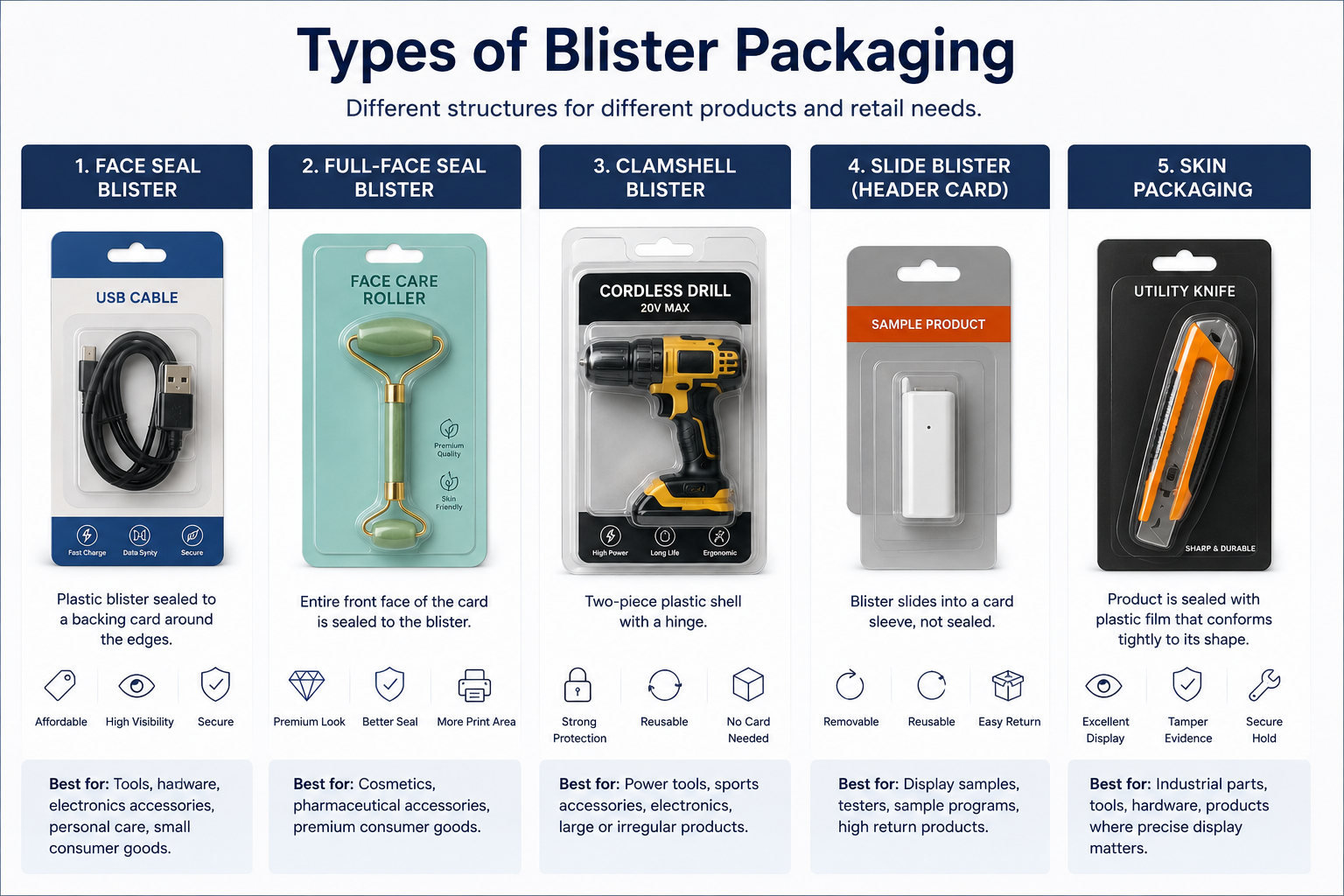
1. Face Seal Blister Packaging
Face seal blister packaging is one of the most common retail blister formats.
A pre-formed plastic blister is heat-sealed onto a printed paperboard backing card. The card usually surrounds the edges of the blister and holds the product securely in place.
Best for:
Tools
Hardware
Cables
Chargers
Adapters
Personal care products
Small consumer goods
Key advantages:
Low tooling cost
Fast production
Strong product visibility
Cost-effective for retail packaging
Face seal blister packaging is a practical choice for brands that need clear product display and basic retail protection at a competitive price.
2. Full-Face Seal Blister Packaging
Full-face seal blister packaging is similar to face seal packaging, but the entire front surface of the card is sealed to the blister, not only the edges.
This creates a flatter and cleaner appearance, making the package look more premium.
Best for:
Cosmetics
Pharmaceutical accessories
Premium consumer goods
Personal care items
Key advantages:
Cleaner appearance
More secure sealing
Better tamper evidence
Larger visual print area
Full-face seal blister packaging is often selected when the product needs both retail visibility and a more polished brand presentation.
3. Clamshell Blister Packaging
Clamshell blister packaging uses a two-piece plastic shell with a hinge. The front and back halves are formed separately or as a folded unit, then closed around the product.
The two halves can be sealed by ultrasonic welding, heat sealing, or mechanical interlocking.
Best for:
Power tools
Sports accessories
Electronic devices
Large or irregularly shaped products
Higher-value retail products
Key advantages:
Strong product protection
No paperboard backing required
Suitable for irregular product shapes
Can be designed to re-open and re-close
Potential drawback:
Clamshell packaging can be harder for consumers to open if it is fully sealed, which may create a negative user experience known as “wrap rage.”
4. Slide Blister Packaging
Slide blister packaging uses a plastic blister that slides into a folded paperboard card instead of being permanently sealed.
This allows the product to be removed and reinserted.
Best for:
Retail display samples
Tester products
Products with high return rates
Sample programs
Reusable display packaging
Slide blister packaging is useful when retailers or customers need to access the product without destroying the package.
5. Skin Packaging
Skin packaging places the product on a porous backing card, then uses heat and vacuum to draw a thin plastic film tightly over the product.
The plastic film conforms closely to the product shape, creating a “second skin” effect.
Best for:
Industrial parts
Tools
Hardware
Small components
Products where precise display matters
Skin packaging is often used when the product shape itself needs to be clearly visible while remaining securely fixed to the card.
Common Blister Packaging Materials
The plastic material used for the blister shell affects clarity, strength, cost, recyclability, forming performance, and market compliance.
Below are the most common plastic materials used for blister packaging.
PVC Blister Packaging
PVC, or Polyvinyl Chloride, is one of the most widely used blister packaging materials globally.
It offers good clarity, strong thermoforming performance, and competitive pricing.
Pros:
Low cost
Widely available
Easy to thermoform
Good clarity
Compatible with many heat-seal coatings
Cons:
Not widely recyclable in most municipal systems
Contains chlorine
May face restrictions in some sustainability-focused markets
Best for:
Cost-sensitive products
General retail packaging
Markets without PVC restrictions
Pharmaceutical blister packaging using appropriate grades
PVC remains common because of its cost and forming efficiency, but brands targeting Europe or sustainability-driven retailers may prefer PET or RPET.
PET Blister Packaging
PET, or Polyethylene Terephthalate, is increasingly used as an alternative to PVC.
It provides excellent clarity, good strength, and better recyclability.
Pros:
Recyclable
Food-safe
Excellent clarity
Strong retail acceptance
Preferred by many sustainability-focused brands
Cons:
Slightly higher cost than PVC
Requires different thermoforming settings
Best for:
Consumer goods
Food-related packaging
Retail packaging for major chains
Brands with sustainability requirements
Products sold in Europe or North America
PET is often the preferred option for brands that want a cleaner sustainability position without sacrificing product visibility.
PP Blister Packaging
PP, or Polypropylene, has higher temperature resistance than PVC or PET.
It is usually translucent rather than fully clear.
Best for:
Medical devices
Automotive parts
High-temperature products
Products requiring sterilization
PP is suitable when temperature resistance or sterilization performance is more important than maximum transparency.
PS Blister Packaging
PS, or Polystyrene, is rigid and brittle compared with other blister materials.
It is less common for standard blister packaging but may be used for shallow trays and display inserts.
Best for:
Shallow trays
Display inserts
Lightweight retail components
RPET Blister Packaging
RPET is made from recycled PET material and is increasingly specified by brands with recycled content targets.
Best for:
Eco-positioned packaging
Brands with recycled content requirements
Retailers with sustainability commitments
Consumer goods packaging
RPET allows brands to improve recycled content claims while keeping the clarity and appearance associated with PET.
Premium Option: Flocked Blister Packaging
For premium or gift-oriented products, blister packaging can include a flocked interior finish.
Flocking adds a soft, velvet-like surface inside the blister shell, creating a more premium look and feel.
Best for:
Cosmetics
Jewelry accessories
Electronics accessories
Gift packaging
Premium product sets
Flocked blister packaging can elevate perceived product value with a relatively modest additional cost.
Backing Card Materials for Blister Packaging
The backing card is just as important as the plastic shell. It provides the main printing surface, supports the product, and affects the overall strength and appearance of the package.
Common backing card materials include:
Coated Folding Carton Board
Coated folding carton board, such as SBS or FBB, is the most common option for blister cards.
It provides a smooth surface for high-quality offset printing.
Typical thickness range:
300–450 gsm
Best for:
Retail blister cards
Cosmetics
Electronics accessories
Personal care products
High-quality printed packaging
Kraft Board
Kraft board has an unbleached brown surface and is often used for eco-positioned or industrial packaging.
Best for:
Eco-style packaging
Hardware
Industrial products
Natural product branding
Foil-Backed Card
Foil-backed card uses aluminum foil laminated to paperboard.
It provides better moisture and light barrier performance and is commonly used in pharmaceutical blister packaging.
Best for:
Pharmaceutical products
Medical accessories
Moisture-sensitive products
Light-sensitive products
Clear Plastic Backing
Some blister formats, such as clamshell packaging, may use all-plastic construction without a paperboard backing card.
Best for:
Clamshell packaging
Fully visible product display
Products requiring stronger plastic enclosure
Printing and Finishing Options
The backing card is a major branding surface. It can support the same finishing options commonly used for folding cartons.
Popular finishing options include:
Matte lamination
Gloss lamination
Soft-touch lamination
Spot UV
Hot foil stamping
Embossing
Debossing
These finishes can help improve shelf appeal and make the overall package look more premium.
When Should You Use Blister Packaging?
Blister packaging is a strong choice when product visibility, retail display, and tamper resistance are important.
You should consider blister packaging when:
The product needs to be visible to consumers
The product is sold in retail stores
The product is small enough to fit into a formed cavity
Retail planogram compliance is required
Theft deterrence is important
Tamper evidence is required
Multiple SKUs need a consistent package format
The product benefits from peg-hole or shelf-ready display
Blister packaging is especially suitable for products that customers want to see before purchase.
When Should You Consider Alternatives?
Blister packaging is not always the best option.
You may want to consider another packaging format when:
The product is too large for cost-effective blister forming
The product requires heavy cushioning
The product is mainly sold through B2B wholesale
The target market has strict PVC restrictions
The product requires a premium unboxing experience
The package needs to be easy to open and reseal
Possible alternatives include:
Folding cartons
Corrugated mailer boxes
Molded pulp trays
Foam inserts
Paperboard inserts
Rigid gift boxes
Retail-ready corrugated packaging
Key Cost Factors for Blister Packaging
Blister packaging cost can vary significantly between suppliers. The final price depends on several factors.
1. Tooling Cost
Each blister shell shape requires a custom thermoforming mold.
Tooling cost depends on:
Product size
Blister depth
Mold complexity
Number of cavities
Mold material
Shape accuracy requirements
Typical tooling cost may range from $200 to $2,000 USD per mold, depending on complexity.
Simple shallow-draw molds are usually less expensive, while deep-draw or multi-cavity molds cost more.
2. Plastic Material and Gauge
The type and thickness of plastic directly affect cost.
A thicker plastic sheet provides more rigidity but also increases material cost.
Gauge selection should be based on:
Product weight
Product shape
Required rigidity
Retail handling conditions
Protection requirements
Using plastic that is too thin may reduce cost at first but can lead to cracking, deformation, or product damage.
3. Backing Card Printing
The backing card is usually offset printed, so its cost depends on:
Card size
Paperboard grade
Number of colors
Artwork complexity
Surface finishing
Lamination or coating requirements
Premium finishes such as foil stamping, spot UV, or embossing will increase cost but can also improve retail presentation.
4. Assembly Method
Different sealing and assembly methods affect both cost and quality.
Common methods include:
Assembly Method | Common Use |
|---|---|
Heat sealing | Standard blister-to-card sealing |
Ultrasonic welding | Clamshell packaging |
RF sealing | High-volume PVC blister packaging |
Mechanical locking | Reclosable or semi-reclosable packs |
The correct method depends on material, package structure, retail requirements, and required seal strength.
5. Order Volume
Blister packaging has strong economies of scale.
Because tooling cost is fixed, higher order volumes reduce the tooling cost per unit.
For example, the per-unit cost at 10,000 units can be significantly lower than at 1,000 units.
For larger orders, buyers may also benefit from:
Better material utilization
Multi-cavity tooling
Faster production efficiency
Lower unit assembly cost
6. Supplier Integration
A supplier that can produce both the plastic blister and printed backing card under one supply chain can reduce coordination cost and quality risk.
Integrated production helps improve:
Color consistency
Lead time control
Fit between blister and card
Seal quality
Final inspection accuracy
Communication efficiency
Huandao’s blister equipment and color printing capability operate under one coordinated supply chain, allowing buyers to manage plastic shell production, printed backing cards, assembly, and quality control through one supplier.
Quality Standards to Check with Your Supplier
Before placing an order, B2B buyers should evaluate both material quality and production control.
Important quality checks include:
Material Certification
For PET or RPET blister packaging, ask for material test certificates that confirm material grade and recycled content percentage.
This is especially important for brands making sustainability claims or selling into regulated retail channels.
Drop Test Results
Blister packaging should withstand standard handling and shipping conditions without cracking, opening, or separating from the card.
For retail and export packaging, buyers may request ISTA or ASTM D4169 testing.
Seal Strength Testing
The seal between the blister shell and the backing card should meet minimum peel force requirements.
This is especially important for:
Retail loss prevention
Tamper evidence
Heavy products
Large blister cavities
Retail compliance
Color Consistency
If your backing card uses Pantone or CMYK brand colors, ask how the supplier controls color consistency across different production runs.
Huandao uses X-Rite spectrophotometry and G7/GMI color control standards to help maintain accurate and repeatable print color.
Clean Room Production
For medical device packaging or pharmaceutical accessories, ask whether the blister packaging can be produced or packed in a controlled environment.
Huandao operates dust-free clean room production for sensitive packaging applications.
How Huandao Produces Blister Packaging
Huandao’s blister packaging capability is supported by three affiliated facilities in Xiamen’s Tongan Industrial Zone.
This integrated structure allows Huandao to provide complete blister packaging from plastic shell to printed card to final assembled unit.
Blister Shell Production
Blister shell production is handled by Xiamen Bailudao Plastic Packaging.
Available materials include:
PVC
PET
PP
PS
Flocked blister
Production equipment includes high-speed automatic thermoforming machines.
Available formats include:
Face seal blister
Full-face seal blister
Clamshell blister
Flocked blister interiors
Backing Card Printing
Backing card printing is handled by Huandao’s main printing facility.
Capabilities include:
Offset lithographic printing
KBA press production
X-Rite color management
Matte lamination
Gloss lamination
Spot UV
Hot foil stamping
Embossing
This allows the blister shell and printed card to be matched accurately before assembly.
Assembly and Quality Control
Final assembly includes heat sealing, mechanical assembly, sample approval, and inspection against approved production samples.
Huandao provides:
Pre-production samples
Heat sealing
Mechanical assembly
Final quality inspection
Packing and shipment coordination
This reduces subcontracting risk and helps ensure consistent quality from start to finish.
Frequently Asked Questions
What Is the Lead Time for Custom Blister Packaging?
Mold production usually takes 5–10 business days.
After mold approval and sample sign-off, standard production lead time is usually 10–15 business days for most orders.
Can I Use Sustainable Materials for Blister Packaging?
Yes. PET, RPET, and PP can be used as alternatives to PVC.
Backing cards can also be produced with FSC-certified board, and soy-based inks may be available for markets that require them.
Do You Produce the Backing Card and Plastic Blister Together?
The printing and blister forming are handled through Huandao’s affiliated production facilities within the same coordinated supply chain.
This allows buyers to manage blister forming, backing card printing, assembly, and quality control through one order process.
What Retail Specifications Can You Meet?
Huandao has experience meeting packaging requirements for major retailers, including Walmart, Costco, and electronics or home improvement retailers.
Buyers should share any specific retail compliance documents during the inquiry stage.
Can I Get a Sample Before Mass Production?
Yes. Huandao can produce a fully assembled sample, including the plastic blister and printed backing card, for approval before full production begins.
Ready to Source Blister Packaging?
Whether you are launching a new product line, consolidating your packaging supply chain, or looking for a more reliable blister packaging manufacturer, Huandao can help.
With integrated blister forming, backing card printing, assembly, and quality control, Huandao provides complete custom blister packaging solutions for retail, electronics, hardware, personal care, medical accessories, and consumer goods.
Request a Blister Packaging Quote →
Browse Our Blister Packaging Gallery →
Learn About Our Integrated Packaging Solutions →
