

Packaging Solutions for Energy Storage Products: What Manufacturers Need to Know
The energy storage industry is growing rapidly. Lithium-ion battery packs, residential energy storage systems, portable power stations, industrial UPS units, and EV charging products are being shipped in higher volumes across global markets.
However, packaging for energy storage products is not the same as packaging for ordinary consumer electronics.
Battery and energy storage products are often heavy, regulated, sensitive to impact, and subject to strict shipping requirements. A packaging failure can result in product damage, shipment delays, compliance issues, and significant cost.
This guide explains what energy storage manufacturers need to know about packaging specifications, material selection, regulatory markings, product protection, and supplier selection.
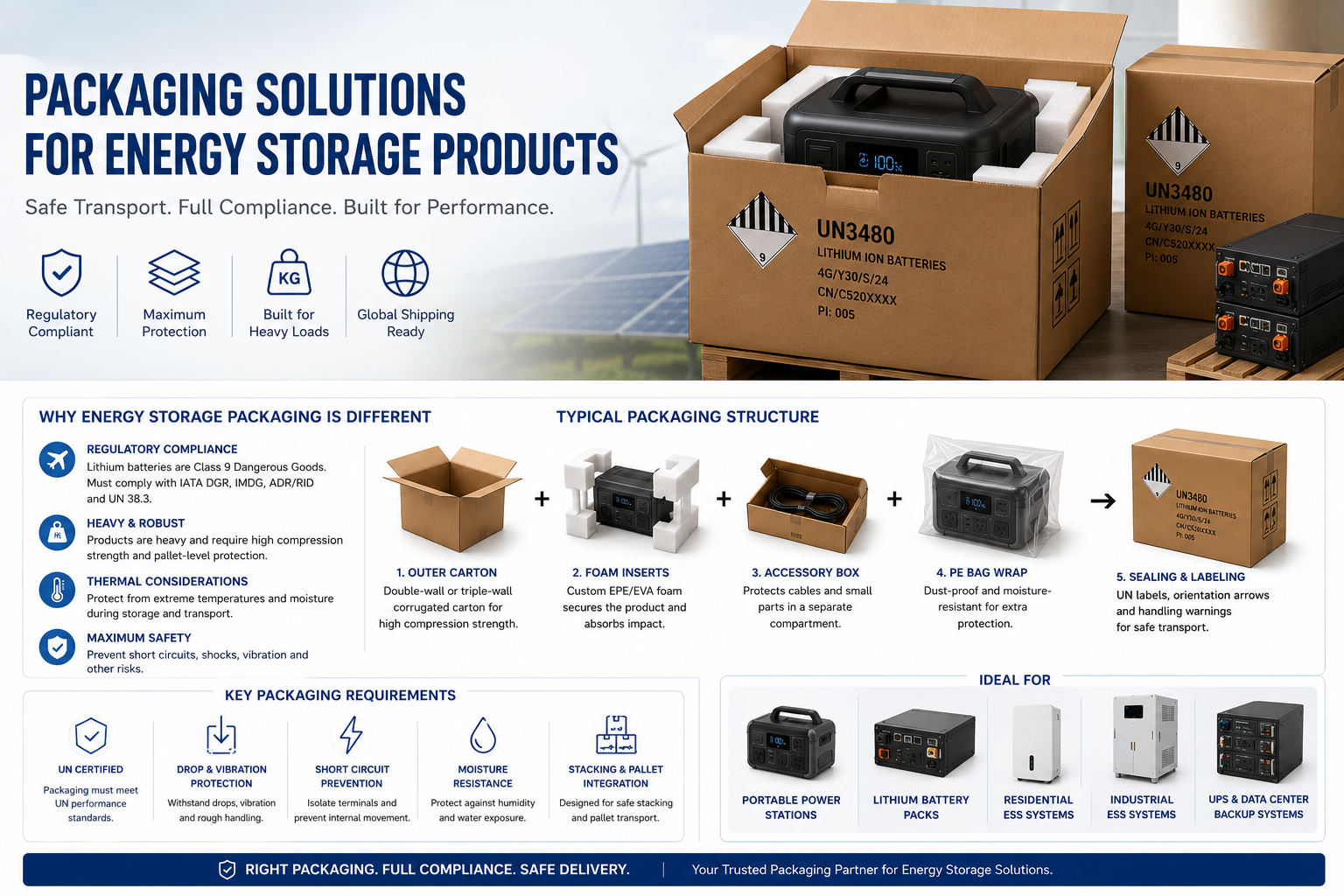
Why Energy Storage Packaging Is Different
Energy storage packaging has higher requirements than general electronics packaging because it must balance several demands at the same time:
Regulatory compliance
Heavy product protection
Drop and vibration resistance
Moisture protection
Pallet-level shipping stability
Retail presentation
International transport requirements
For manufacturers shipping batteries, ESS products, and power stations globally, packaging must be engineered as part of the product supply chain, not treated as a basic shipping box.
Regulatory Requirements for Battery Shipping
Most modern energy storage products use lithium battery technology.
Lithium batteries are classified as Class 9 Dangerous Goods under international transport regulations.
This may apply to:
Lithium-ion batteries
Lithium metal batteries
Battery packs
Equipment containing lithium batteries
Battery packs shipped separately from equipment
Portable power stations
Residential ESS modules
Industrial UPS systems
Because of this classification, battery packaging must follow strict transport rules.
Key Regulatory Frameworks
IATA Dangerous Goods Regulations
IATA DGR applies to air freight.
Lithium batteries are tightly regulated in air transport. Requirements may include restrictions on state of charge, packaging specifications, labels, documentation, and handling procedures.
For certain lithium-ion battery shipments, state of charge may need to be limited to 30% or less.
IMDG Code
The International Maritime Dangerous Goods Code applies to sea freight.
It covers dangerous goods transported by ocean container and includes specific packaging, marking, labeling, and documentation requirements for lithium batteries.
ADR / RID
ADR and RID apply to road and rail transport in Europe.
These regulations are relevant for final-mile and regional distribution after products arrive in Europe.
UN 38.3
UN 38.3 is the transport safety testing standard for lithium batteries.
Lithium batteries must pass UN 38.3 before they can be transported. The test series covers:
Altitude simulation
Thermal testing
Vibration
Shock
External short circuit
Impact
Overcharge
Forced discharge
Packaging teams should work with logistics, compliance, and freight partners to confirm which transport requirements apply to each product and route.
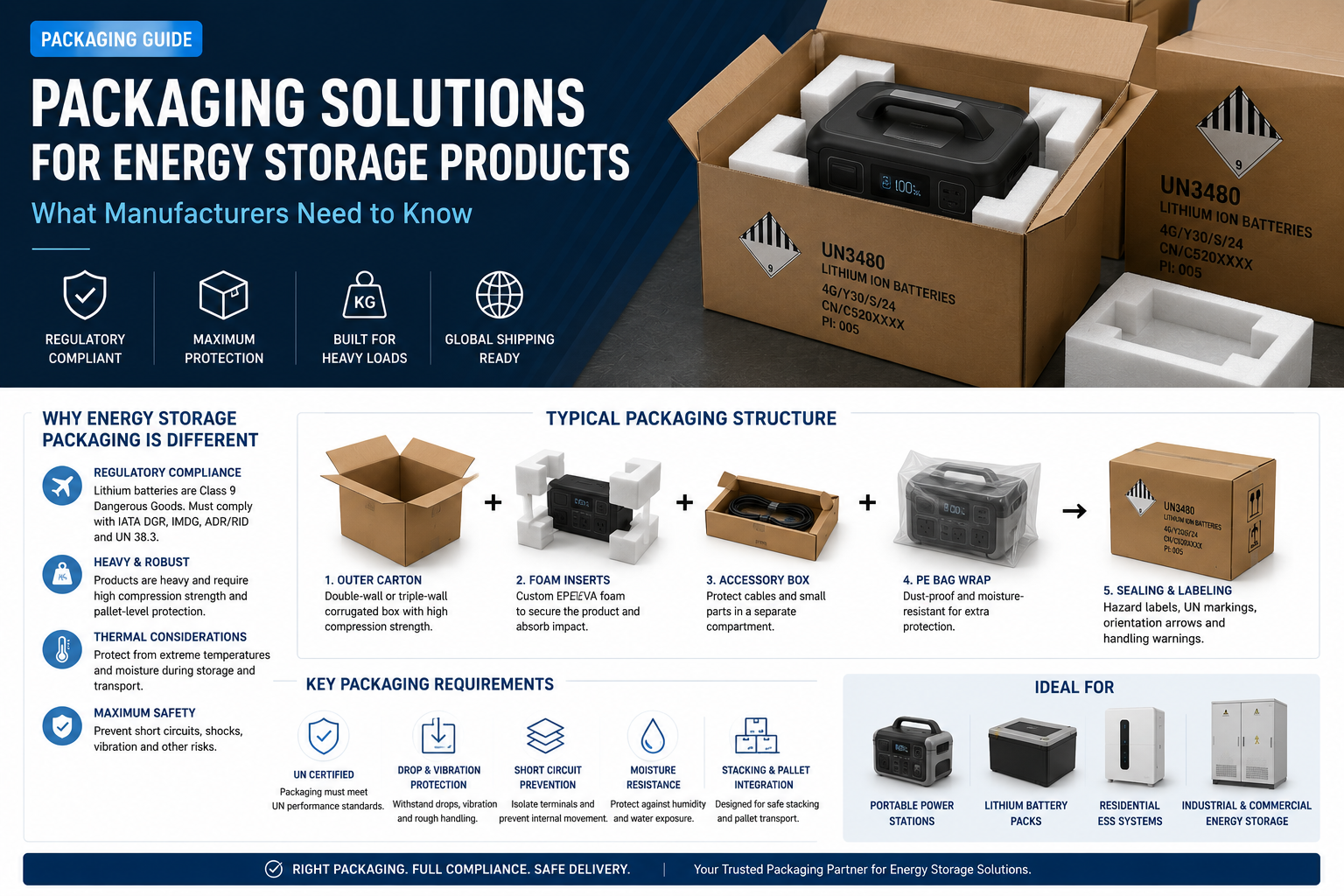
Product Weight and Physical Demands
Energy storage products are often much heavier than standard electronics.
Examples include:
Portable power stations
Lithium battery packs
Residential ESS modules
Industrial battery systems
UPS units
EV charging accessories
A residential ESS module may weigh 30–100 kg, while larger industrial systems can weigh several hundred kilograms.
This creates serious packaging engineering requirements.
Heavy energy storage packaging must consider:
Compression strength
Edge crush resistance
Foam density
Drop protection
Vibration resistance
Pallet integration
Forklift handling
Moisture exposure
Long-distance freight conditions
A standard lightweight carton is not suitable for these products.
Thermal and Moisture Considerations
Lithium batteries can be sensitive to extreme storage and transport conditions.
Depending on the product chemistry, market, and shipping route, packaging may need to account for:
High-temperature routes
Cold-weather shipping
Long warehouse storage
High-humidity environments
Ventilation requirements
Moisture barrier needs
For products shipped through humid sea routes or stored in semi-outdoor environments, water-resistant coatings or moisture-barrier liners may be required.
Common Packaging Formats for Energy Storage Products
Energy storage packaging usually combines a strong outer carton, engineered internal protection, accessory organization, moisture protection, labeling, and pallet-level handling.
1. Outer Corrugated Shipping Cartons
The most common outer packaging format for energy storage products is a double-wall or triple-wall corrugated carton.
The carton must be engineered for:
Compression strength
Stackability
Edge crush resistance
Drop resistance
Moisture resistance
Pallet handling
Regulatory label placement
Common Flute Specifications
Corrugated Type | Best For | Key Benefit |
|---|---|---|
BC-Flute Double-Wall | Medium-weight energy storage products | Strong compression and cushioning |
EB-Flute Double-Wall | Retail-ready energy storage packaging | Better surface for printing and stacking |
Triple-Wall Corrugated | Heavy industrial battery modules | High structural performance |
For medium-weight products between 5–25 kg, BC-flute double-wall corrugated is commonly used.
For products that need both retail presentation and shipping strength, EB-flute double-wall can be a strong option.
For heavy industrial battery modules above 25 kg, triple-wall corrugated may be required.
2. High-Performance Board Specifications
Board strength is determined by liner and medium weights.
For energy storage packaging, high-performance liners are often specified to achieve the required Box Compression Test values.
Common liner weights may include 150–175 g/m² or higher, depending on product weight and stacking requirements.
Packaging should be validated based on:
Product weight
Carton dimensions
Pallet stacking height
Shipping route
Warehouse storage conditions
Freight handling method
3. Moisture-Resistant Corrugated Packaging
Battery products can be sensitive to moisture.
For high-humidity routes or outdoor storage conditions, buyers may specify:
Water-resistant coatings
Moisture-barrier liners
PE bag wrapping
Desiccant packs
Shrink wrapping
Stretch wrapping
Pallet-level moisture protection
This is especially important for sea freight, tropical routes, and long-term warehousing.
Interior Protection Systems
The inside of the package is where most product protection is created.
For energy storage products, the insert must prevent product movement, absorb impact, organize accessories, and protect terminals or exposed components.
1. EPE Pearl Cotton Foam Inserts
EPE pearl cotton, also known as expanded polyethylene foam, is one of the most common cushioning materials for battery and energy storage packaging.
It provides:
Drop impact absorption
Vibration protection
Product positioning
Moisture resistance
Lightweight cushioning
Some thermal insulation
For heavier products, foam density must be carefully specified.
Foam Density Selection
For energy storage products above 10 kg, higher-density EPE foam is usually required.
A common range is 25–35 kg/m³, depending on product weight, fragility, drop height, and foam thickness.
If foam density is too low, the product may compress the foam completely during a drop event. This is called bottoming out, and it can lead to product damage even if the package looks well cushioned.
Common Foam Configurations
EPE foam inserts may be designed as:
Top and bottom foam pads
Corner foam blocks
Full-perimeter foam wrap
Cavity-cut foam blocks
Layered foam protection
Terminal protection pads
Accessory compartments
For heavy or high-value energy storage products, cavity-cut foam blocks and full-perimeter protection are often preferred.
2. Corrugated Internal Partitions and Trays
Corrugated internal partitions are used to separate components and organize accessories.
They are useful for:
Multi-unit battery packs
Accessory kits
Cables
Adapters
Mounting hardware
Manuals
Small replacement parts
Corrugated trays can organize accessories in a clear assembly sequence, which improves both packing efficiency and user experience.
3. Accessory Boxes and Inner Packaging
Energy storage products often ship with cables, chargers, adapters, mounting hardware, manuals, and documentation.
These components should not move freely inside the main carton.
Common accessory packaging options include:
Printed accessory boxes
Corrugated trays
Paperboard pouches
PE bags
Molded trays
Labeled hardware kits
Organized accessory packaging helps reduce product scratches, missing parts, and user confusion.
4. Wooden Pallet Integration
For heavy ESS units and industrial battery systems, packaging often needs to be designed as a pallet-level system.
This may include:
ISPM 15 heat-treated wooden pallets
Custom pallet dimensions
Carton-to-pallet strapping
Stretch wrapping
Shrink wrapping
Corner protection
Forklift handling clearance
Pallet stack stability
The carton, foam insert, and pallet should be engineered together so the product can survive real freight conditions.
Retail Presentation Packaging for Consumer ESS
For consumer-facing energy storage products such as portable power stations and residential power units, packaging often needs to protect the product and also function as retail packaging.
This creates a dual requirement:
Strong enough for heavy product shipping
Attractive enough for retail display
A common approach is to use a litho-laminated corrugated carton.
This allows the outer shipping carton to carry:
Full-color product graphics
Lifestyle photography
Brand messaging
Product specifications
Regulatory markings
Handling symbols
Retail barcode information
This can eliminate the need for a separate retail box, reducing total material cost while maintaining shelf presentation.
Key Regulatory Markings for Battery Packaging
Energy storage packaging may need specific markings depending on battery type, capacity, transport mode, and destination market.
Important markings may include:
UN Specification Markings
For packaging certified to UN transport specifications, the carton may need a UN specification marking.
This marking can include:
UN packaging symbol
Packaging code
Performance standard
Year of manufacture
Country code
Manufacturer identity
Gross weight limit
These markings must be accurate and positioned correctly on the carton.
Lithium Battery Handling Labels
Battery packaging may require lithium battery handling labels or Class 9 dangerous goods labels.
These labels vary depending on:
Battery chemistry
Whether batteries are packed alone or with equipment
Transport mode
Destination market
Freight regulation category
Transport Pictograms
Standard transport symbols are commonly used on energy storage packaging.
Examples include:
Fragile
This way up
Keep dry
Handle with care
Heavy package
Do not stack, where applicable
These can be printed directly on the carton or applied as labels.
Destination Market Compliance Marks
Depending on market and product type, packaging may also need to support:
CE marking
UL documentation
UN certification documents
Product safety notices
User manuals
Recycling markings
Retail compliance labels
A packaging supplier experienced in energy storage products should account for these markings during the artwork and structural design stage.
What to Look for in an Energy Storage Packaging Supplier
Energy storage packaging requires a higher supplier qualification standard than general packaging.
Manufacturers should look for suppliers with experience in heavy product packaging, foam engineering, testing coordination, regulatory labeling, and integrated production.
1. Experience With Heavy Product Packaging
Ask whether the supplier has designed packaging for products above:
10 kg
25 kg
50 kg
100 kg
A supplier with real heavy-product experience should understand:
Foam density selection
Compression strength
BCT requirements
Pallet integration
Forklift handling
Drop testing
Long-distance freight risks
2. In-House Foam Fabrication
Energy storage packaging often depends on the fit between the outer carton and internal foam.
If the carton and foam are produced by different suppliers, dimensional mismatch can occur.
Common problems include:
Foam too large for carton
Product cavity too loose
Carton cannot close properly
Product shifts during transport
Assembly line delays
Higher rejection rates
An integrated supplier that produces both corrugated packaging and EPE foam inserts can reduce these risks.
Huandao’s integration with Xiamen Fujisheng Packaging Technology brings EPE pearl cotton fabrication in-house, allowing foam inserts and outer cartons to be engineered, sampled, and delivered together.
3. Drop Testing Support
Professional energy storage packaging should be validated through testing.
Relevant standards may include:
ISTA protocols
ASTM D4169
Customer-specific test standards
Retailer-specific packaging requirements
Before mass production, buyers should confirm whether the packaging design can be tested as a complete system, including product, foam insert, carton, accessory packaging, and pallet configuration when applicable.
4. Regulatory Knowledge
A packaging supplier does not replace a dangerous goods consultant or freight forwarder.
However, the supplier should understand enough about battery packaging to:
Leave space for required labels
Use appropriate carton structures
Support UN packaging requirements where needed
Incorporate handling symbols correctly
Avoid artwork revisions caused by missing compliance marks
Coordinate documentation packaging
This reduces risk during final shipment preparation.
5. Color Quality for Retail Packaging
For consumer energy storage products, the carton may be part of the retail presentation.
If the packaging uses lifestyle photography, product images, or brand colors, print quality matters.
Litho-laminated corrugated packaging with good color management can help ensure:
Better photo reproduction
Consistent brand color
Clear product specifications
Professional shelf appearance
Repeatable quality across reorders
Huandao’s G7 Master certification and X-Rite color management system support consistent color across packaging runs.
Huandao’s Energy Storage Packaging Capability
Huandao has supplied packaging to multiple publicly listed manufacturers in China’s energy storage sector, including companies operating in residential ESS, industrial battery systems, and EV charging infrastructure.
Huandao’s energy storage packaging capability includes:
Corrugated Case Production
Single-wall corrugated cases
Double-wall corrugated cases
Triple-wall corrugated cases
BC-flute and EB-flute structures
High-performance liner specifications
Litho-laminated corrugated retail packaging
Full-color offset printing for consumer ESS packaging
Interior Protection Systems
EPE pearl cotton foam inserts
Custom foam density and thickness
Full-perimeter foam protection
Cavity-cut foam blocks
Corrugated internal partitions
Accessory trays
Thermoformed accessory trays
Integrated Supply
Huandao can provide a complete packaging system, including:
Outer shipping carton
Inner foam insert
Accessory packaging
Printed documentation
Regulatory marking support
Pre-production samples
Packaging engineering review
This allows manufacturers to source the full packaging system through one supplier and reduce coordination risk.
Frequently Asked Questions
Does My Energy Storage Packaging Need UN Certification?
It depends on battery chemistry, battery capacity, shipment configuration, and transport mode.
Lithium batteries shipped by air, sea, road, or rail may have different packaging requirements.
Your freight forwarder or dangerous goods consultant should confirm the applicable regulations.
Huandao can design packaging to support UN specification standards when required.
What Foam Density Should I Specify for a 20 kg Power Station?
As a starting point, 25–30 kg/m³ EPE foam may be appropriate for a 20 kg unit with moderate fragility.
However, the final specification should be calculated based on:
Product weight
Product fragility
Drop height requirement
Foam thickness
Package design
Shipping route
Huandao’s engineering team can provide a cushion design calculation during the packaging review stage.
Can the Shipping Carton Also Serve as Retail Packaging?
Yes.
This is common for consumer ESS products.
Litho-laminated corrugated allows one carton to provide both shipping strength and retail-quality graphics.
This reduces total material use and removes the need for a separate retail box.
What Is the Typical Lead Time for Custom Energy Storage Packaging?
For new tooling, such as foam molds or die-cut tools, allow around 5–10 business days for tooling.
After sample approval, standard production lead time is usually 10–15 business days.
For repeat orders using existing tooling, lead time is usually shorter and more predictable.
Can You Supply Packaging for Europe and the U.S. Markets?
Yes.
Huandao has experience with packaging for products sold into European and U.S. markets, including familiarity with EU packaging requirements, REACH-related material considerations, ISTA testing, and U.S. retail compliance needs.
Source Energy Storage Packaging from Huandao
Energy storage packaging requires more than a strong box.
Manufacturers need packaging that protects heavy battery products, supports regulatory compliance, organizes accessories, survives global freight conditions, and presents the brand professionally when sold through retail channels.
Huandao provides integrated packaging solutions for energy storage manufacturers, including corrugated cases, EPE foam inserts, accessory packaging, regulatory marking support, retail-quality printing, and pre-production sampling.
With in-house foam fabrication, corrugated production, G7 color management, and experience supporting energy storage companies, Huandao can help manufacturers develop packaging that is safe, compliant, and ready for global distribution.
View Our Energy Storage Packaging Case Studies →
Request a Heavy Product Packaging Consultation →
Get a Custom Packaging Quote →
