

How Bathroom & Sanitary Ware Brands Source Custom Packaging from China
Bathroom and sanitary ware packaging is one of the most demanding categories in custom packaging.
Products such as faucets, showerheads, toilets, vanities, bathroom accessories, and water purification equipment are often heavy, fragile, irregularly shaped, and sold through retail channels with strict packaging requirements.
For global sanitary ware manufacturers, sourcing packaging from China can offer strong cost advantages. However, successful sourcing depends on choosing the right supplier, specifying the correct structure, and managing packaging quality across long-distance supply chains.
This guide explains the key packaging challenges in the sanitary ware industry, common packaging formats, print quality requirements, and what brands should look for when sourcing custom packaging from China.
Why Sanitary Ware Packaging Is More Demanding
Sanitary ware products combine several packaging challenges at once.
They are often heavy, fragile, high-value, finish-sensitive, and sold through multiple distribution channels. A packaging failure can lead to product damage, retail rejection, installation delays, or costly warranty claims.
For this category, packaging must do more than contain the product. It must protect, organize, present, and comply.
Packaging Challenges for Bathroom and Sanitary Ware Products
1. Heavy and Dense Products
Many bathroom and sanitary ware products are made from heavy materials such as brass, stainless steel, zinc alloy, ceramic, glass, and engineered stone.
Examples include:
Faucet sets
Showerheads
Mixer taps
Bathroom hardware
Ceramic toilets
Vanity cabinets
Basin sets
Water purification equipment
A faucet set may weigh 3–5 kg, while a toilet suite can exceed 30 kg. A vanity cabinet with basin may weigh 50 kg or more.
This creates packaging requirements that are much higher than standard consumer goods packaging.
For heavy sanitary ware products, buyers should specify:
Correct board grade
High-performance corrugated liners
Box Compression Test values
Suitable insert density
Drop test requirements
Pallet stacking requirements
Reinforced corners or internal structures
Heavy products should not be packed in standard lightweight cartons without structural validation.
2. Complex and Irregular Shapes
Sanitary ware products are rarely simple box-shaped items.
A faucet may include a tall central body, side handles, protruding spouts, threaded connectors, and small fittings.
A showerhead may include a circular head, flexible hose, mounting bracket, and articulating arm.
A toilet suite may include a pan, cistern, seat, and accessories, each with a different geometry.
Because of this complexity, standard inserts are rarely enough.
Custom inserts are usually required to:
Hold each component in place
Prevent movement during shipping
Protect protruding parts
Separate accessories from finished surfaces
Support the product during drops and vibration
Improve packing efficiency
For sanitary ware packaging, custom-engineered inserts are not a luxury option. They are often a basic requirement for safe transit.
3. Fragile Surfaces and Premium Finishes
Many sanitary ware products feature delicate visible finishes, such as:
Polished chrome
Brushed nickel
Matte black
Antique brass
Brushed gold
Ceramic glaze
Glass surfaces
Powder-coated metal
These finishes are highly visible after installation. Even a small scratch can result in a return, claim, or customer complaint.
The insert must protect both the structure and the surface.
A good sanitary ware packaging design should:
Prevent movement inside the box
Avoid abrasive contact with the product surface
Protect handles, spouts, corners, and connection points
Use materials that do not react with metallic finishes
Include surface wrapping such as PE film or foam sleeves when needed
For polished chrome and other sensitive finishes, EPE foam is commonly used because it is chemically inert, non-abrasive, and dimensionally stable.
4. Different Retail and Distribution Requirements
Bathroom and sanitary ware products are sold through several channels, each with different packaging requirements.
A single product line may need to serve big-box retail, trade distributors, kitchen and bath showrooms, and e-commerce fulfillment.
This means packaging must be engineered for both freight performance and retail presentation.
Packaging Requirements by Sales Channel
Big-Box Retail
Retailers such as home improvement chains and large-format stores often require strict packaging specifications.
Common requirements include:
Standardized outer carton dimensions
Planogram compliance
High-quality printed graphics
Barcode placement
Retail shelf readability
FSC-certified materials
Drop testing
Compression testing
Clear product identification
For big-box retail, packaging must look good on shelf and perform reliably in distribution.
Trade Distributors
Trade distributor packaging usually focuses more on freight durability and warehouse efficiency.
Important requirements include:
Strong master cartons
Pallet stability
Clear SKU identification
Easy warehouse picking
Durable labeling
Installation documents included
Product protection during bulk shipping
Print quality may be less important than structural strength, but product identification must be clear.
Kitchen and Bath Showrooms
In showrooms, packaging may be opened in front of customers or installers.
This makes inner presentation more important.
Showroom packaging should provide:
Clean product organization
Premium inner presentation
Protective inserts
Clear documentation
Branded inner components
A better unboxing experience
For premium sanitary ware brands, the inside of the package can influence perceived product value.
E-Commerce Fulfillment
E-commerce packaging faces individual parcel handling rather than palletized freight.
This means the package may be dropped, rotated, stacked, or handled roughly during courier delivery.
E-commerce sanitary ware packaging may require:
Stronger outer cartons
Better internal cushioning
ISTA 2A or ISTA 6 testing
No additional outer packaging
Protection for individual delivery routes
Easy returns handling
For heavy or fragile sanitary ware products, e-commerce packaging must be tested as a complete system.
Common Packaging Formats for Sanitary Ware
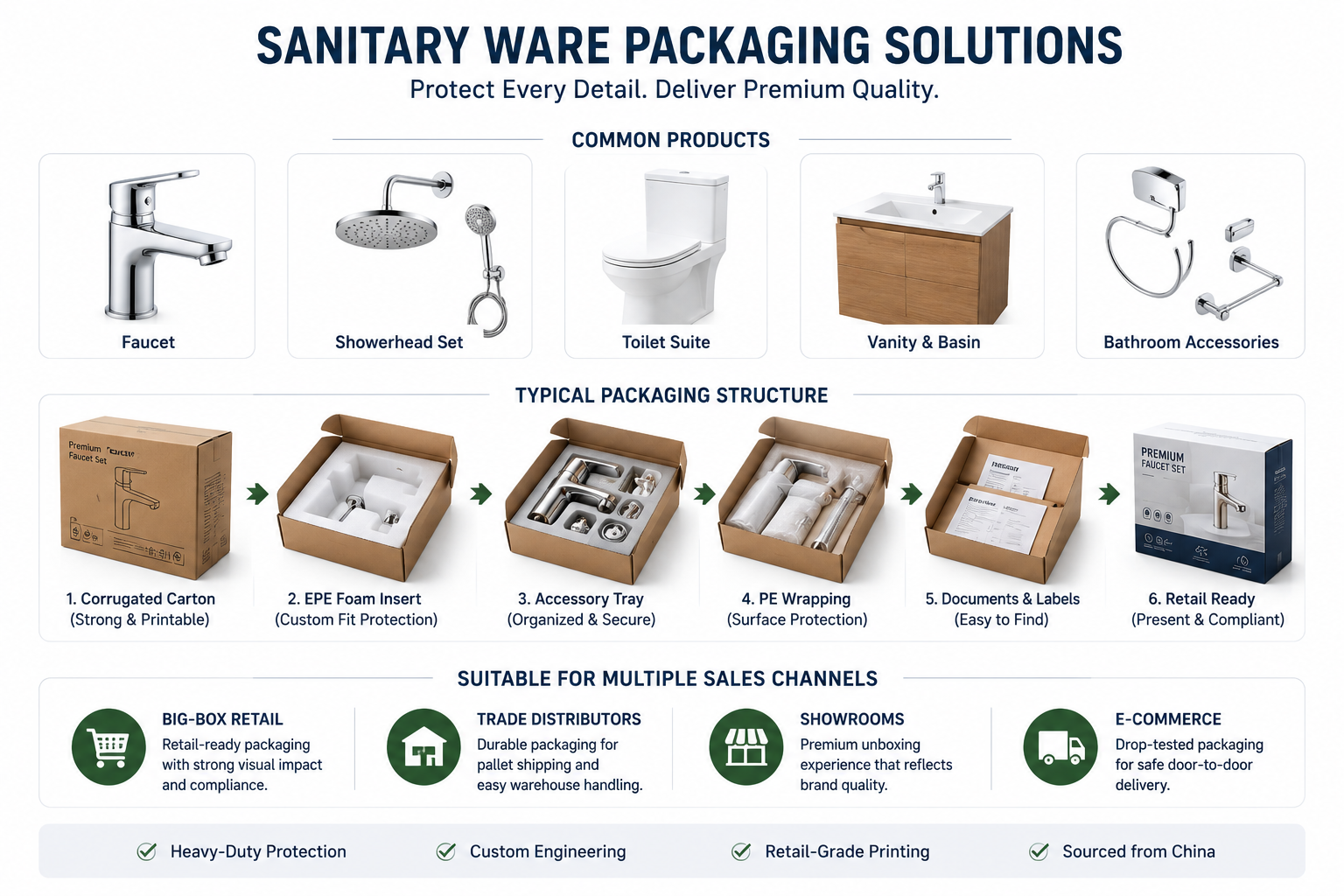
Sanitary ware packaging usually combines outer corrugated cartons, engineered inserts, accessory trays, printed documentation, and labels.
The correct combination depends on product weight, finish, retail channel, and shipping route.
1. Outer Corrugated Cartons
Corrugated cartons are the primary outer packaging format for sanitary ware.
For lighter accessories, single-wall corrugated may be enough.
For faucets, fixtures, toilets, vanities, and heavier items, double-wall or even triple-wall corrugated may be required.
Common Corrugated Specifications
For sanitary ware packaging, common board choices include:
C-flute for general protection
BC double-wall for heavier fixtures
EB double-wall for better print surface and strength
Triple-wall corrugated for heavy suite items
High-performance liners for heavy loads
For heavy products, BCT should be specified and validated based on product weight and pallet stacking height.
Typical BCT values may range from 2,000–4,000 N for standard retail cartons, with higher values required for heavier suite items.
2. Litho-Laminated Corrugated Cartons
For sanitary ware products sold through retail, print quality is important.
Litho-laminated corrugated is often the preferred solution.
In this process, a high-quality lithographic printed sheet is laminated onto corrugated board.
This provides:
Strong corrugated structure
Retail-quality graphics
High-resolution product images
Rich color reproduction
Fine-line detail
Better brand presentation
Litho-laminated corrugated is especially suitable for:
Faucets
Showerheads
Bathroom accessories
Premium fixture sets
Big-box retail packaging
Product lines with lifestyle photography
3. Direct Flexographic Printed Cartons
Direct flexographic printing is a more cost-effective option for simpler corrugated packaging.
It is suitable for basic artwork, one-color to four-color designs, and cartons where freight durability matters more than high-resolution retail presentation.
Best for:
Trade distributor cartons
Master cartons
Simple shipping cartons
Cost-sensitive product lines
Warehouse-focused packaging
Flexographic printing is practical, but it may not achieve the same photo quality or color accuracy as litho-laminated corrugated.
4. EPE Pearl Cotton Foam Inserts
EPE pearl cotton foam is one of the most important insert materials for sanitary ware packaging.
It provides cushioning, surface protection, and positional control.
EPE foam is commonly used for:
Faucets
Showerheads
Mixer taps
Polished hardware
Water purification components
Ceramic or metal fittings
High-value bathroom accessories
Example: Faucet Packaging Insert System
A complete faucet packaging insert may include:
Bottom foam pad with shaped cavity
Side foam pads to prevent lateral movement
Top foam pad to protect spout and handles
Accessory tray for nuts, bolts, hoses, and installation parts
PE film wrapping for surface protection
Dedicated compartment for instruction manuals
This structure helps protect the faucet from scratches, impact, and movement during shipping.
5. Corrugated Internal Structures
Corrugated internal structures are used to organize multiple components inside one carton.
They may include:
Dividers
Partitions
Folded trays
Corner protectors
Accessory boxes
Sleeve inserts
These structures are useful when packaging:
Faucet sets with accessories
Toilet suite components
Shower systems
Bathroom hardware kits
Multi-piece product bundles
Corrugated inserts are cost-effective and recyclable, but they usually provide positioning rather than heavy cushioning. For fragile or finish-sensitive items, they are often combined with foam.
6. Thermoformed Trays
Thermoformed plastic trays are less common for heavy sanitary ware fixtures, but they are useful for smaller retail accessories.
They provide a clean, structured interior presentation and precise component positioning.
Best for:
Soap dispensers
Towel rails
Mirror accessories
Small bathroom hardware
Premium accessory kits
Retail display packaging
For higher-end accessories, thermoformed trays can improve presentation and make the packaging feel more organized.
Installation Documentation Packaging
Sanitary ware packaging has a unique requirement: installation documentation.
Unlike many consumer goods, sanitary ware products often need detailed instructions, mounting templates, warranty cards, and hardware kits.
For installers and DIY customers, documentation must be easy to find.
Best practices include:
Place manuals in a dedicated pocket
Attach documentation to the inner carton lid
Use a clearly labeled compartment
Bag and label hardware kits by installation step
Place mounting templates on top of the product
Keep warranty cards visible and protected
Good documentation packaging reduces installation frustration and improves the overall product experience.
Why Print Quality Matters for Sanitary Ware Packaging
Sanitary ware is a considered purchase.
A faucet or shower system may retail at a mid-to-high price point, and buyers often compare products carefully before making a decision.
Packaging influences how consumers perceive the product’s quality.
For premium bathroom brands, packaging print quality communicates:
Product value
Brand reliability
Finish quality
Design positioning
Retail shelf impact
Professional manufacturing standards
Poor print quality can make even a high-quality product feel lower-end.
Color Consistency Across Product Ranges
A bathroom hardware range may include many SKUs, finish options, and configuration variants.
For example, one product family may include:
Chrome finish
Brushed nickel finish
Matte black finish
Brushed gold finish
Single-handle version
Dual-handle version
Matching accessories
All cartons in the range need to look visually consistent on shelf.
If each batch has slightly different colors, the product line can appear inconsistent or poorly managed.
This is why color management is important.
A calibrated color system, such as G7-controlled offset printing with X-Rite measurement, helps maintain consistent brand colors across SKUs and production runs.
Huandao’s G7 Master and GMI certifications support this requirement for sanitary ware brands that need stable, repeatable packaging color.
Lifestyle Photography Reproduction
Premium sanitary ware packaging often uses lifestyle photography, showing the product installed in a bathroom environment.
These images help customers understand the finish, design style, and intended use.
To reproduce lifestyle photography well on corrugated packaging, litho-laminated printing is usually preferred.
It provides better:
Image detail
Color accuracy
Contrast
Skin tone and interior tone reproduction
Product finish representation
Retail presentation
For premium sanitary ware sold through retail channels, this print quality can directly influence shelf appeal.
Supply Chain Considerations When Sourcing from China
Sourcing sanitary ware packaging from China can reduce cost and provide access to integrated manufacturing capability.
However, buyers must manage supplier selection carefully.
A good packaging supplier should understand both packaging engineering and category-specific sanitary ware requirements.
Why Integrated Supply Matters
One of the biggest risks in sanitary ware packaging is fragmented sourcing.
For example:
Outer carton from one supplier
Foam insert from another supplier
Labels from a third supplier
Manuals from a fourth supplier
This creates several risks:
Dimensional mismatch
Insert does not fit the carton
Carton does not close properly
Components move during transit
Delayed sample approval
Multiple quality control points
Higher coordination cost
Longer lead times
An integrated packaging supplier reduces these risks by managing all components under one system.
What an Integrated Packaging Supplier Should Provide
For sanitary ware brands, an integrated supplier should be able to produce or manage:
Outer corrugated cartons
Litho-laminated retail cartons
Direct-print shipping cartons
EPE foam inserts
Corrugated dividers and trays
Inner color boxes
Product labels
Installation manuals
Warranty cards
Hardware kit organization
Pre-production samples
Quality testing support
This simplifies purchasing and improves consistency across the complete packaging system.
Huandao’s production group covers these key components, allowing brands to source outer cartons, foam inserts, printed collateral, and documentation packaging through one supplier.
Managing High-SKU Packaging Programs
Sanitary ware brands often manage many SKUs.
A single range may include multiple product models, finish options, market versions, and retailer-specific packaging variations.
This makes tooling and sample management important.
A qualified supplier should support:
SKU-level tooling records
Approved sample retention
Color reference management
Reorder documentation
Modular structural design
Shared tooling where possible
Consistent print across repeat orders
Huandao maintains a die-cut tooling library by client and SKU, helping reorders move into production efficiently without unnecessary tooling cost.
Lead Time Management
Packaging delays can hold up finished sanitary ware inventory.
This is especially problematic for new product launches, seasonal programs, and retailer promotions.
To reduce lead time risk, buyers should look for a supplier with:
In-house design capability
In-house sampling
In-house printing
In-house die cutting
Foam insert fabrication
Strong production capacity
Organized reorder process
Clear pre-production approval workflow
Huandao’s large production facility and integrated manufacturing system help support both scheduled orders and urgent packaging programs.
Huandao’s Experience in Sanitary Ware Packaging
Huandao has supplied packaging for major sanitary ware and bathroom product brands, including Kohler, Waterpik, and JOMOO.
This category experience helps Huandao understand:
Heavy product packaging requirements
Finish protection needs
Custom insert engineering
Retail channel compliance
High-SKU range management
Installation documentation packaging
Color consistency across product lines
FSC material requirements
Huandao’s sanitary ware packaging capabilities include:
Litho-laminated corrugated cartons
Direct-print corrugated cartons
Custom EPE foam inserts
Corrugated inner partitions
Accessory trays
Retail inner color boxes
Installation documentation printing
Hardware kit packaging coordination
Pre-production samples
G7 Master and GMI color management
FSC-certified materials
Frequently Asked Questions
How Do You Protect Polished Chrome and Brushed Nickel Finishes During Transit?
Polished chrome, brushed nickel, and other metallic finishes require non-abrasive surface protection.
EPE foam is commonly used because it is chemically inert and non-abrasive.
Products are usually wrapped in PE film before being placed into the foam insert. For especially sensitive finishes, additional foam wrapping strips or full-product foam sleeves can be specified.
Can You Produce Packaging for a Range of 20+ SKUs With Coordinated Branding?
Yes.
High-SKU sanitary ware ranges can be managed through modular packaging design.
Common carton dimensions may be standardized across related SKUs, while product-specific insert cavities and layouts are adjusted for each model.
This helps reduce tooling investment while maintaining consistent brand presentation.
Do You Have Experience With Home Depot or Lowe’s Packaging Specifications?
Yes.
Huandao has experience supporting brands that supply North American big-box home improvement retail channels.
Relevant requirements may include:
FSC certification
ISTA testing
Planogram compliance
Retail carton dimensions
Barcode placement
Retail-ready graphics
Color consistency
What Is the MOQ for Custom Corrugated Sanitary Ware Packaging?
MOQ depends on product size, structure, print method, and SKU count.
For litho-laminated corrugated packaging, a standard MOQ is often around 1,000–2,000 units per SKU.
For direct-print corrugated cartons, lower MOQs may be available depending on the specification.
How Do You Manage Tooling Costs for a High-SKU Range?
Die-cut tooling is usually a one-time investment per SKU.
Huandao maintains and inventories tooling at its facility for reorders. For similar products, the engineering team can advise whether certain tooling can be shared or standardized to reduce total cost.
Can You Include Installation Documentation and Hardware Kits in the Packaging?
Yes.
Installation manuals, templates, warranty cards, labels, and hardware kits can be coordinated as part of the complete packaging specification.
Documentation printing can be handled within Huandao’s print capability or coordinated with the client’s documentation supplier.
Source Custom Sanitary Ware Packaging from Huandao
Sanitary ware packaging requires more than a standard box.
Heavy products, delicate finishes, irregular shapes, retail requirements, and installation documentation all need to be considered together.
Huandao helps bathroom and sanitary ware brands source complete custom packaging solutions from China, including corrugated cartons, foam inserts, retail boxes, printed documentation, labels, and FSC-certified materials.
With integrated production, G7/GMI color management, in-house sampling, foam insert capability, and experience serving major sanitary ware brands, Huandao can support both new product launches and ongoing high-SKU replenishment programs.
View Our Sanitary Ware Packaging Case Studies →
Request a Consultation for Your Packaging Range →
Get a Custom Packaging Quote →
