

 The box is only half of the job.
For electronics manufacturers, the insert inside the box is often the part that determines whether the product arrives safely, looks premium, and delivers a strong unboxing experience.
A poorly designed insert can cause product movement during shipping, cosmetic scratches, damaged connectors, higher return rates, and customer complaints.
A well-designed insert does the opposite. It holds the product securely in place, absorbs impact during freight handling, organizes accessories, and creates a more professional first impression.
This guide explains the main types of box inserts used in electronics packaging, when to use each material, and how to brief your packaging supplier correctly.
Why Box Inserts Matter for Electronics Packaging
Electronics packaging has more demanding requirements than many other product categories.
The insert must protect the product, organize components, and support the brand presentation at the same time.
High Product Value
A damaged electronics product is not just a minor packaging issue. It can become a warranty claim, a return, a replacement cost, or a customer service escalation.
In many cases, the cost of one damaged product can exceed the cost of packaging an entire shipment.
This is why choosing the right insert material and structure is critical for electronics brands.
Dimensional Precision
Electronics products often include screens, connectors, PCBs, machined housings, lenses, buttons, and surface finishes that require precise protection.
Even small product movement inside the box can cause:
Surface scratches
Connector damage
Screen abrasion
Cosmetic defects
Loose accessories
Internal impact damage
A good insert should hold the product securely without applying excessive pressure.
Multi-Component Kitting
Most electronics products ship with multiple components, such as:
Charging cables
Adapters
Manuals
Warranty cards
Remote controls
Mounting accessories
Batteries
Replacement parts
Each component needs a defined position inside the box.
If a cable or adapter moves freely during transit, it can scratch or damage the main product.
Unboxing Experience
Consumers expect electronics packaging to feel organized, intentional, and premium.
A box filled with loose foam or random void fill can make the product feel lower quality before the customer even uses it.
A well-designed insert improves the unboxing experience by presenting the product clearly and professionally.
Main Types of Box Inserts for Electronics Packaging
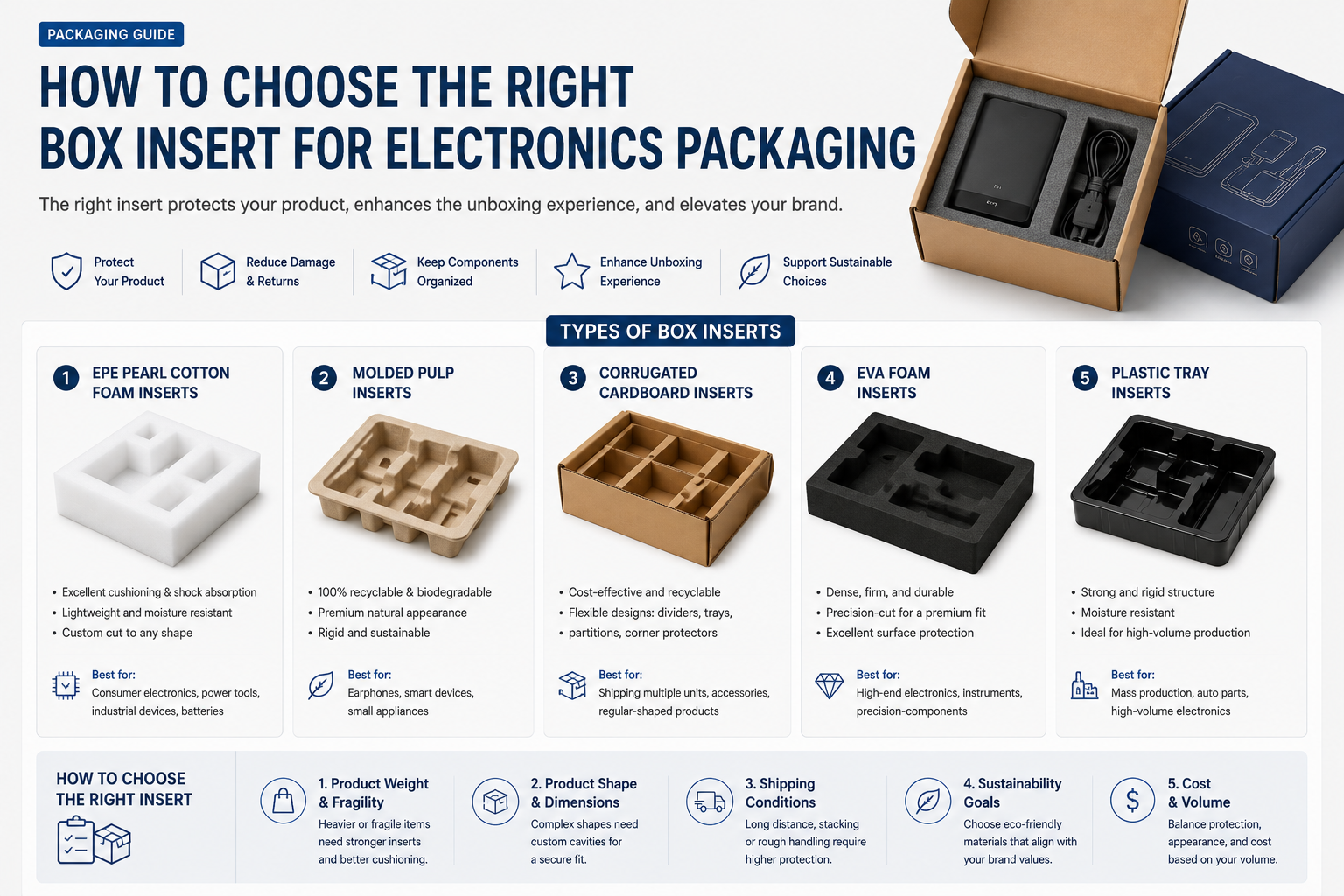
There are several types of box inserts available for electronics products. The right choice depends on product weight, fragility, shape, retail positioning, sustainability requirements, and budget.
1. EPE Pearl Cotton Foam Inserts
EPE pearl cotton, also known as expanded polyethylene foam, is one of the most widely used insert materials for electronics and industrial products.
It is a closed-cell foam that provides strong cushioning, moisture resistance, and lightweight protection.
Key Advantages
Excellent cushioning against drops and vibration
Good moisture resistance
Lightweight and easy to handle
Clean white appearance
Can be CNC-cut, die-cut, or hot-wire cut
Suitable for custom cavities and complex product shapes
Density Options
EPE foam is usually specified by density.
Lower density foam, such as 15–20 kg/m³, provides softer cushioning for lightweight products.
Higher density foam, such as 25–35 kg/m³, provides firmer support for heavier or more impact-sensitive products.
Common Formats
EPE inserts can be made in several forms:
Full-perimeter wrap
Top and bottom clamshell insert
Custom-cut cavity insert
Layered foam insert
Foam blocks and corner protection
Accessory compartments
Best For
EPE pearl cotton inserts are suitable for:
Consumer electronics
Power tools
Industrial devices
Energy storage batteries
Sanitary ware fittings
Products requiring freight cushioning
Huandao’s acquisition of Xiamen Fujisheng Packaging Technology in 2024 expanded its in-house EPE insert capability, allowing foam inserts and outer packaging to be supplied under one coordinated order.
2. Molded Pulp Inserts
Molded pulp inserts, also called molded fiber inserts, are made by forming recycled paper pulp into a three-dimensional tray or cavity.
They are increasingly popular for brands that want sustainable packaging with a premium natural appearance.
Key Advantages
100% recyclable and biodegradable
Plastic-free packaging option
Lightweight and rigid
Premium matte natural texture
Suitable for sustainable brand positioning
Good product presentation
Limitations
Requires a mold for each product shape
Tooling cost applies
Less cushioning than foam for heavy drop impact
Lower moisture resistance than EPE foam
Best For
Molded pulp inserts are suitable for:
Earphones
Smart home devices
Small appliances
Lightweight electronics
Sustainable product packaging
Retail unboxing applications
Molded pulp is a strong choice when sustainability and product presentation are more important than heavy-duty shock absorption.
3. Corrugated Cardboard Inserts
Corrugated cardboard inserts are made from die-cut corrugated board or carton board. They can be folded into trays, dividers, partitions, sleeves, or corner protectors.
This is one of the most cost-effective insert solutions.
Common Formats
Corrugated inserts can be produced as:
Partition inserts
Folded trays
Corner protectors
Sleeve inserts
Dividers
Accessory compartments
Key Advantages
Low cost
Recyclable
FSC-certifiable
Easy to customize
Can be printed
Good for organizing components
No tooling cost for simple structures
Limitations
Minimal cushioning
Better for positioning than impact absorption
Not ideal as the only insert for fragile electronics
Best For
Corrugated cardboard inserts are suitable for:
Master carton partitions
Multi-unit shipments
Accessory organization
Kitting layouts
Regular-shaped products
Cost-sensitive packaging
For fragile electronics, corrugated inserts are often combined with foam, molded pulp, or outer cushioning.
4. Vacuum-Formed Plastic Trays
Vacuum-formed plastic trays, also known as thermoformed trays, are made by heating a plastic sheet and forming it over a mold.
Materials commonly include PET, PVC, PS, or RPET.
This insert format is common in consumer electronics because it allows precise product positioning and a clean presentation.
Key Advantages
Very precise cavity shapes
Good product organization
Clear or colored plastic options
Suitable for automated packing
Consistent dimensions
Can hold multiple accessories in dedicated positions
Limitations
Tooling cost required for each SKU
Less sustainable than paper-based alternatives
Some materials may become brittle in extreme cold conditions
Best For
Thermoformed plastic trays are suitable for:
Consumer electronics
Small appliances
Earbuds
Chargers
Smart devices
Multi-accessory kits
High-volume production
5. Flocked Plastic Trays
A flocked tray is a thermoformed plastic tray with a soft velvet-like surface coating.
This gives the insert a premium look and also helps prevent scratches.
Key Advantages
Premium tactile appearance
Excellent product positioning
Scratch protection
Suitable for gift-style presentation
Enhances the unboxing experience
Best For
Flocked trays are suitable for:
High-end audio products
Premium electronics
Professional tools
Flagship consumer devices
Gift packaging
Product launch kits
Huandao’s affiliated blister and plastic packaging facility can produce thermoformed and flocked trays in-house.
6. Foam-in-Place Inserts
Foam-in-place packaging uses two-component polyurethane foam that expands around the product inside the box.
It creates a custom-fit protective shell without requiring a mold.
Key Advantages
Excellent cushioning
Custom fit for irregular shapes
No hard tooling required
Good for low-volume or one-off products
Limitations
High per-unit cost
Not reusable
More difficult to apply consistently
Not ideal for commercial-scale consumer products
Best For
Foam-in-place inserts are suitable for:
Industrial electronics
Scientific equipment
Large fragile products
Irregular-shaped products
Low-volume custom shipments
7. Air Column Bags
Air column bags are inflatable plastic cushions used around the product inside the shipping box.
They are often used as flexible void fill or perimeter protection.
Key Advantages
Lightweight
Flexible
Good for variable box sizes
Useful for e-commerce fulfillment
Reduces impact during shipping
Limitations
Less premium appearance
Not ideal for structured retail packaging
May not provide precise product positioning
Best For
Air column bags are suitable for:
E-commerce fulfillment
Variable-size shipments
Courier shipping
Non-premium protective packaging
Flexible cushioning needs
Box Insert Material Comparison
Insert Type | Cushioning | Precision Fit | Cost | Sustainability | Visual Appeal | Best Application |
|---|---|---|---|---|---|---|
EPE Pearl Cotton | Excellent | High | Medium | Medium | Medium | Electronics, industrial products, heavy items |
Molded Pulp | Medium | High | Medium-High | Excellent | Excellent | Sustainable brands, light electronics |
Corrugated Insert | Low-Medium | Medium | Low | Excellent | Basic | Master cartons, kitting, multi-unit packaging |
Thermoformed Plastic Tray | Medium | Excellent | Medium | Low-Medium | High | Consumer electronics, accessories |
Flocked Tray | Medium | Excellent | Medium-High | Low | Excellent | Premium electronics, gifting |
Foam-in-Place | Excellent | Excellent | High | Low | Basic | Industrial, fragile, irregular products |
Air Column Bag | Medium | Low | Low-Medium | Low | Basic | E-commerce shipping, void fill |
How to Choose the Right Box Insert
When choosing an insert for electronics packaging, start with the product requirements rather than the outer box.
1. Product Dimensions and Weight
Provide exact product dimensions in millimeters:
Length
Width
Height
Weight
Position of fragile areas
Protruding features
The insert should be designed from the product outward, not from the outer box inward.
2. Product Fragility
Clarify how fragile the product is and which areas need extra protection.
Important questions include:
Does the product have a screen?
Are there exposed connectors?
Are there buttons, lenses, ports, or antennas?
Which surfaces scratch easily?
What drop height must the package survive?
Are there existing drop test results?
This information determines whether foam, molded pulp, plastic tray, or a hybrid solution is appropriate.
3. Component List
Every accessory should have a dedicated position.
Provide dimensions for:
Cables
Adapters
Manuals
Warranty cards
Batteries
Remote controls
Mounting parts
Spare accessories
A clear component list helps prevent loose parts from damaging the main product during shipping.
4. Packing Method
The packing process affects insert design.
For manual packing, the insert should be easy for workers to load quickly and consistently.
For automated packing, the insert must meet tighter tolerances and orientation requirements for robotic handling.
5. Shipping and Retail Environment
Different distribution channels require different insert solutions.
For example:
Air courier shipments need better drop protection
Sea freight needs humidity and stacking resistance
Retail packaging needs better presentation
Warehouse fulfillment needs faster packing efficiency
Export packaging may require stronger cushioning
The insert, outer box, and shipping method should be designed as one system.
6. Sustainability Requirements
If your brand or retail partner requires plastic-free packaging, molded pulp or corrugated inserts may be better options.
If plastic inserts are still needed, RPET thermoformed trays can help support recycled content goals.
Sustainable insert options include:
Molded pulp inserts
FSC-certified corrugated inserts
RPET plastic trays
Recyclable paperboard trays
7. Budget and Order Volume
Insert cost depends on material, structure, tooling, labor, and order volume.
For low-cost applications, corrugated inserts may be sufficient.
For fragile products, EPE foam or molded pulp may be more appropriate.
For high-volume consumer electronics, thermoformed trays can offer consistent quality and efficient packing.
For premium products, flocked trays or molded pulp can improve perceived value.
Common Mistakes to Avoid
Mistake 1: Designing the Insert from the Outer Box First
The insert should be designed around the product.
If the outer box is selected first and the insert is forced to fit later, the result may be too tight, too loose, or poorly balanced.
The correct order is:
Product geometry
Insert structure
Outer box size
Transit testing
Final production
Mistake 2: Using Foam Density That Is Too Low
Soft foam may look protective, but if the product is too heavy, the foam can compress fully and fail during impact.
Foam density should be selected based on:
Product weight
Drop height
Fragility level
Target G-value
Shipping conditions
Mistake 3: Ignoring the Packaging System
The insert, product, and outer box work together.
Testing only the insert or only the outer box is not enough.
A complete packaging test should include:
Product
Insert
Inner box
Outer carton
Final packed configuration
Mistake 4: Using Different Suppliers for Box and Insert
When the box and insert come from different suppliers, dimensional tolerance problems can occur.
A small difference in box size plus a small difference in insert size can cause:
Crushed inserts
Loose product fit
Box closing issues
Poor assembly efficiency
Higher rejection rate
Single-source supply can reduce these risks.
Huandao’s Integrated Insert Capability
For electronics manufacturers sourcing packaging from China, integrated supply can reduce cost, lead time, and quality risk.
Huandao’s production group covers the full electronics packaging system:
EPE pearl cotton inserts
Thermoformed plastic trays
Flocked plastic trays
Corrugated inserts
Carton board inserts
Outer corrugated shipping cartons
Retail color boxes
Printed inner components
This means buyers can source a complete electronics packaging solution from one supplier, including:
Outer shipping carton
Inner retail box
Foam insert
Molded pulp insert
Thermoformed tray
Printed backing card
Accessory compartments
Pre-production samples
With one engineering review and one quality control process, Huandao helps reduce supplier coordination problems and improve dimensional consistency.
Frequently Asked Questions
What Is the Tooling Cost for a Custom Foam Insert?
CNC-cut EPE foam inserts typically do not require hard tooling. Shapes are cut from standard foam sheets using CNC equipment.
Custom molds are usually required for thermoformed plastic trays and molded pulp inserts. Typical tooling costs may range from $100 to $1,500 USD, depending on the structure and complexity.
Can I Get a Pre-Production Sample Before Mass Production?
Yes. Huandao can produce complete pre-production package assemblies, including the outer box, inner box, and insert, for approval before full production.
What Drop Testing Standards Can Your Inserts Meet?
Huandao designs inserts using ISTA 1A, 2A, and 3A protocols as standard references.
For clients with specific retail requirements, such as Amazon SIOC or Walmart packaging specifications, the insert and outer package can be designed to those protocols directly.
How Do I Know What Foam Density I Need?
The recommended foam density depends on product weight, fragility, drop height, and stacking requirements.
Huandao’s engineering team can calculate the appropriate foam density as part of the new-product packaging review.
Do You Offer Sustainable Insert Alternatives?
Yes. Molded pulp is the main recommendation for plastic-free or sustainability-focused packaging.
Other available options include RPET thermoformed trays and FSC-certified corrugated inserts.
Material certification documentation can be provided for sustainable insert options.
Get Your Electronics Insert Designed Right the First Time
Choosing the right insert is essential for protecting electronics during shipping and creating a better customer experience.
Send Huandao your product dimensions, component list, fragility requirements, shipping method, and target market. Our packaging engineers can recommend the right insert material, structural design, and indicative cost before tooling investment begins.
Request a Custom Insert Consultation →
Download Our Electronics Packaging Checklist →
Explore Our Full Product Range →
